
Which home appliances use the most electricity—and how to cut their use
Learn how to compare appliance electricity use, calculate kWh and estimate running costs with practical examples—not a misleading universal ranking.
By TopicWeekPublished 8 min read

In this article
The appliance with the highest wattage is not automatically the one that uses the most electricity over a month. What matters is the energy it draws while it runs, how long it runs, how often it cycles and—when it heats or cools—a home’s climate and insulation. That is why a generic ranking can mislead: a resistive heater used for hours and a kettle switched on briefly tell very different stories.
Watts and kilowatt-hours measure different things
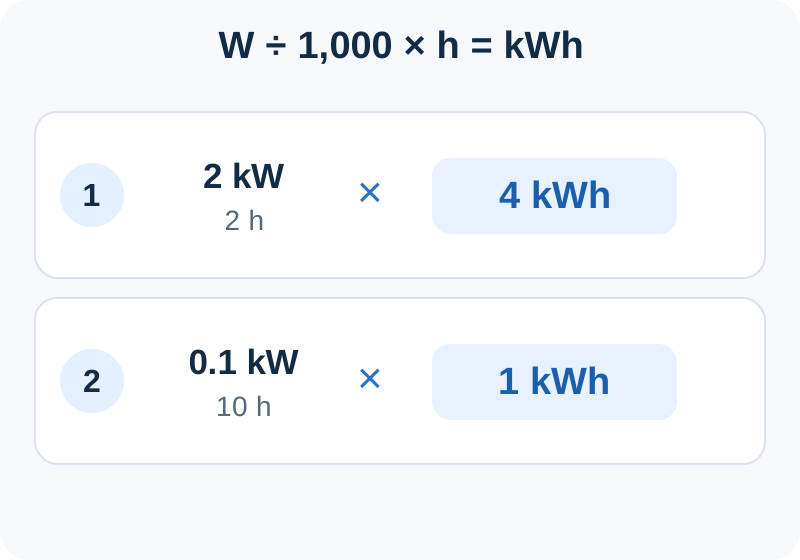
A watt (W) measures power: the rate at which a device uses energy at a moment. One kilowatt (kW) is 1,000 W. A watt-hour (Wh) measures energy; a kilowatt-hour (kWh) is the energy used by a 1 kW load over one hour. For a steady load, or a reasonable average input power, use energy (kWh) = power (W) × time (hours) ÷ 1,000. A nameplate value may be rated or maximum input, not the average draw throughout a cycle.
Estimate the energy cost
For a simple tariff, estimated variable energy cost = kWh × price per kWh. A 2,000 W resistive heater operating at full power for 2 hours a day over 30 days would use 2 kW × 2 h × 30 = 120 kWh. At an explicitly hypothetical rate of €0.25/kWh, that is €30 for the energy component. The rate is an arithmetic example, not a current national price. Replace it with the applicable usage rate on your bill. A thermostat may reduce the heater’s actual full-power hours.
The multiplication estimates the part of a bill that changes with energy use. A full bill can also include fixed charges, time-of-use prices, taxes, delivery or regulated charges and other items that vary by country and contract. With different hourly rates, use the rate for the period when the appliance runs; shifting a load can reduce cost without reducing kWh.
Which appliances can add up to more?
Electric space heating, air conditioning and electric water heating can be major uses where a home relies on them, because they move or add heat for long periods. The result depends on climate, building size, insulation, equipment efficiency, set point and hours of use. A heat pump transfers heat rather than turning all its electricity directly into heat, so its electrical input is not the same as its heat output. COP is a ratio under specified conditions; seasonal ratings such as SCOP or SEER describe performance over defined test or seasonal methods, not a guaranteed household result. The U.S. Department of Energy explains the heat-transfer principle and why performance varies by system and conditions.

- Heating, cooling and water heating: check whether the system is electric, its input power or seasonal energy data, how it is controlled and the hours it actually runs. Do not count gas use as electricity.
- Refrigerators and freezers: they stay connected all day but cycle on and off. Size, ambient temperature, door openings, seals, ventilation and settings affect use.
- Laundry and dishwashing: energy per cycle depends on programme, load, temperature, water heating and machine design. A tumble dryer used often may matter more than one used occasionally.
- Cooking and small appliances: ovens and resistance hobs can draw substantial power while on; kettles and hair dryers can have high wattage but short runtimes. Electronics usually draw less at a moment, but screens, computers and always-on devices accumulate use over time.
What to compare for each appliance
- Heating/cooling/water heating: compare input kWh over a representative month or season; rated watts need actual runtime or measured average. For a heat pump, use electrical input, not heat output.
- Refrigerator/freezer: use annual label kWh where available; compare similar capacity and test methods. Ambient temperature and installation affect real use.
- Washer/dishwasher: compare kWh per cycle or 100 cycles for the same labelled programme, then multiply by actual matching cycles.
- Kettle/oven/hair dryer: estimate from input watts and minutes, or measure a representative use; short runtime matters.
- TV/computer/router/standby: record accumulated kWh over a representative period with a suitable meter; standby is not automatically the largest load.
Use cycles and labels on their own terms
Do not estimate a refrigerator by multiplying its maximum compressor power by 24 hours. It cycles as the thermostat responds to heat entering the cabinet. For a model covered by the EU label, the label reports annual kWh under a standard test; dividing by 365 gives an approximate daily comparison, not a promise about a particular kitchen. Ambient temperature, capacity, installation and use change the result. The European Commission’s refrigerator label also gives capacity and noise information, and its EPREL registry provides model data.
For EU household washing machines, the rescaled A–G label reports weighted electricity use per 100 cycles of the Eco 40–60 programme; the dishwasher label reports energy per 100 eco cycles. Divide by 100 only to form a simple per-cycle equivalent for that test programme. It does not predict every programme or load. Other markets use different label systems: for example, ENERGY STAR is a U.S.-origin efficiency programme, and U.S. EnergyGuide labels use their own categories and assumptions. Compare products of similar type and size, then check the model’s test basis and the label used where you live.
Heating water can be an important part of a washer’s energy demand when the machine heats the wash water electrically. Lower-temperature programmes can use less energy when suitable for the fabric, soil and detergent, but a quick programme is not automatically the lowest-energy choice. Follow garment and appliance instructions; run appropriately full loads rather than overloading.
Four examples on the same 30-day basis
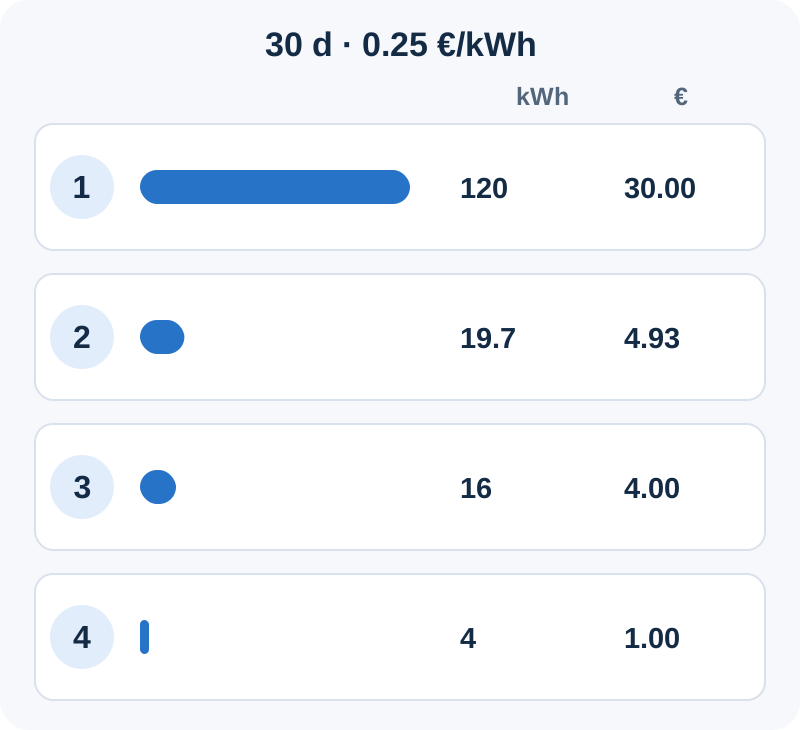
The following are transparent scenarios, not averages or a ranking of all homes. They use the same illustrative €0.25/kWh rate. The refrigerator and washer values are deliberately identified as hypothetical label-style inputs so you can replace them with the figures for a real model.
- 1. Resistive heater: 2,000 W at full power, 2 h/day × 30 days = 120 kWh; 120 × €0.25 = €30. A thermostat or lower duty cycle reduces actual use.
- 2. Kettle used briefly: 2,000 W for 4 min/day × 30 days. 4 minutes = 4/60 h, so 2 × (4/60) × 30 = 4 kWh, or €1. Water volume and starting temperature matter in real use.
- 3. Refrigerator: assume a label-style 240 kWh/year. For 30 days: 240 × 30/365 = 19.7 kWh, about €4.93. This annual figure is a hypothetical input, not a typical value for every fridge.
- 4. Washing machine: assume 80 kWh/100 cycles on a specified label programme and 20 such cycles in 30 days. 80/100 × 20 = 16 kWh, or €4. Actual programmes and loads may differ.
How to check your own consumption
Start with the appliance label or manual, then look for accumulated kWh rather than only instantaneous watts. A plug-in energy meter or a smart plug with energy measurement can record a cycle, but check that it is rated for the appliance’s voltage, current and load type. Do not use a low-rated smart plug with a high-power heater, oven or other load. Some equipment is hard-wired and must be assessed through a suitable meter or by a qualified electrician—do not open an electrical panel.
A single reading can miss compressor or thermostat cycles. Measure over a representative period that includes ordinary settings and use; compare like with like. A smart meter or utility portal may show whole-home interval consumption but not identify a particular appliance automatically. The U.S. Department of Energy’s standby measurement guidance likewise notes that fluctuating loads should be measured over time and averaged, rather than inferred from one moment.
Ways to reduce use without compromising comfort or safety
- Use heating and cooling controls thoughtfully, maintain equipment as its maker recommends, and reduce avoidable heat loss or gain where practical. Do not apply a universal thermostat setting or savings percentage to every climate.
- For laundry, choose a suitable lower-temperature or eco programme, use an appropriate load, and avoid unnecessary drying when air-drying is practical and safe. For dishwashers, use the eco programme and follow loading guidance.
- Keep refrigerator seals clean and intact, allow required ventilation, avoid prolonged door opening and use the temperature settings recommended by the manufacturer. Do not switch off food refrigeration for savings.
- Compare the energy label when replacing a unit, but consider size, purchase price, repairability and expected use—not just the letter grade. Unplug or switch off non-essential standby devices only when doing so does not interrupt safety, health, network or update functions.
- If a tariff has time-varying rates, shifting flexible use may lower the bill. It changes the cost timing, not necessarily the kWh consumed.
When does replacing an appliance make sense?
Compare a measured or label-based estimate for the old unit with a comparable new model. Estimated annual energy saving = (old kWh/year − new kWh/year) × your variable price per kWh. A simple payback estimate is purchase and installation cost ÷ annual bill saving. This excludes repairs, financing, changing tariffs, product life, disposal and environmental impacts; it is not a guarantee. If the calculated saving is small, the appliance works safely and repair is reasonable, replacement may not make financial sense.
Common assumptions to avoid
- More watts does not always mean more monthly kWh: operating time and cycling matter.
- A refrigerator’s rated compressor power is not its continuous 24-hour draw.
- Standby can add up across devices, but it is not automatically the largest household load.
- A label is a standardized comparison, not a measurement of your home; rating scales and test methods differ by market and product category.
- A per-kWh price estimates variable energy charges, not every line on the electricity bill.
- Replacing an appliance does not always pay back; calculate the difference using your use and local price.
A practical way to start
Pick the equipment that heats, cools or runs often. Record its kWh over a representative period, or use a label value with its test assumptions. Apply the variable price from your own contract, then change one safe habit or setting and compare again. That household-specific measurement is more useful than a universal list of ‘worst’ appliances.
Official label and measurement sources
For label details, consult the European Commission pages for refrigerators, washing machines and dishwashers. The U.S. FTC explains EnergyGuide estimates for its market, while the U.S. Department of Energy describes standby-power measurement. These sources use market-specific systems and test conditions. For a worked running-cost method, the Government of South Australia provides a calculator and formula; its default rate is Australian and should not be reused elsewhere.
Related guides
Home
How to Paint a Room Step by Step: Materials, Preparation and Common Mistakes
Plan materials, prepare walls, estimate paint quantity and apply it safely with a roller and brush. Includes drying times, common mistakes and a worked example.
11 min read

Home
Are Solar Panels Worth It for Your Home? Costs, Savings and Payback
What a home solar PV system costs, how much electricity it produces, how much of it you actually use, what happens to the surplus and how to work out payback, with three worked examples and the cases where it does not pay off.
27 min read

Home
Christmas Decorating Ideas for Small Spaces: Practical Ways to Save Room
How to decorate a small flat, studio or single room for Christmas without losing space: compact and wall trees, vertical decor, renter-friendly ideas and decorations that store easily.
15 min read