
How much water does AI really use?
AI is linked to water use through data-center cooling and electricity generation. Learn what the figures mean, why they vary, and what we know about water per query.
By TopicWeekPublished 11 min read
In this article
When a question reaches an AI assistant, servers calculate the answer using electricity and producing heat. Some infrastructure uses water to remove that heat, and the electricity itself may carry a water footprint at the power plants that generate it. AI is therefore associated with water use, though not necessarily where you type or on the device in front of you.
“How much water does AI use?” sounds like a request for one number. In practice it depends on the model, query length and complexity, hardware, data-center utilization, cooling system, climate and which parts of the chain are counted. Per-prompt figures illustrate a specific methodology; they are not universal meters.
How much water does AI really use?
There is no public, comparable measurement of AI’s total water consumption worldwide. Most data centers combine cloud, storage, web services and AI tasks, and operators rarely break water use down by model or workload. Attributing all a facility’s water to AI would overstate AI’s share; treating the impact as zero because no breakdown exists would hide a real effect.
A useful, clearly scoped reference comes from Lawrence Berkeley National Laboratory (LBNL). It estimated that all U.S. data centers directly consumed about 66 billion liters of water in 2023. The same report estimated nearly 800 billion liters of indirect water consumption associated with the electricity those facilities used. These are national estimates for all data centers, not AI alone; they measure different pathways and should not be added without explaining their boundaries. (LBNL report)
A production study by Google and its co-authors estimated the median Gemini Apps text prompt in May 2025 at 0.26 milliliters. The full energy methodology accounts for accelerators, CPU, memory, reserved idle capacity and data-center overhead; but to estimate water, the paper subtracts that overhead energy before applying the serving fleet’s average WUE Category 2 (1.15 L/kWh, the 2023 and 2024 average). It is therefore a service-specific estimate of on-site cooling-water consumption based on serving telemetry—not a universal figure for Gemini, ChatGPT or all AI, and not necessarily representative of 2026 systems. It excludes indirect water from electricity generation and hardware manufacturing. (original study by Google and co-authors)
Why there is no universal figure per prompt
A prompt is not a fixed unit of work. “What time is it?” and asking a model to analyze a long document, write code or generate an image can require different amounts of computation. The selected model, hardware, response length, request batching and share of active or idle servers allocated to the service also matter.
Studies do not always count the same things. One may include only water evaporated for cooling; another adds estimated water consumed to generate electricity; a third includes reserved capacity, shared infrastructure or manufacturing. A low figure with a narrow boundary and a higher one with a broader boundary can both be valid, even if they cannot be compared directly. Water intensity also changes with the hour and season.
Where a data center uses water
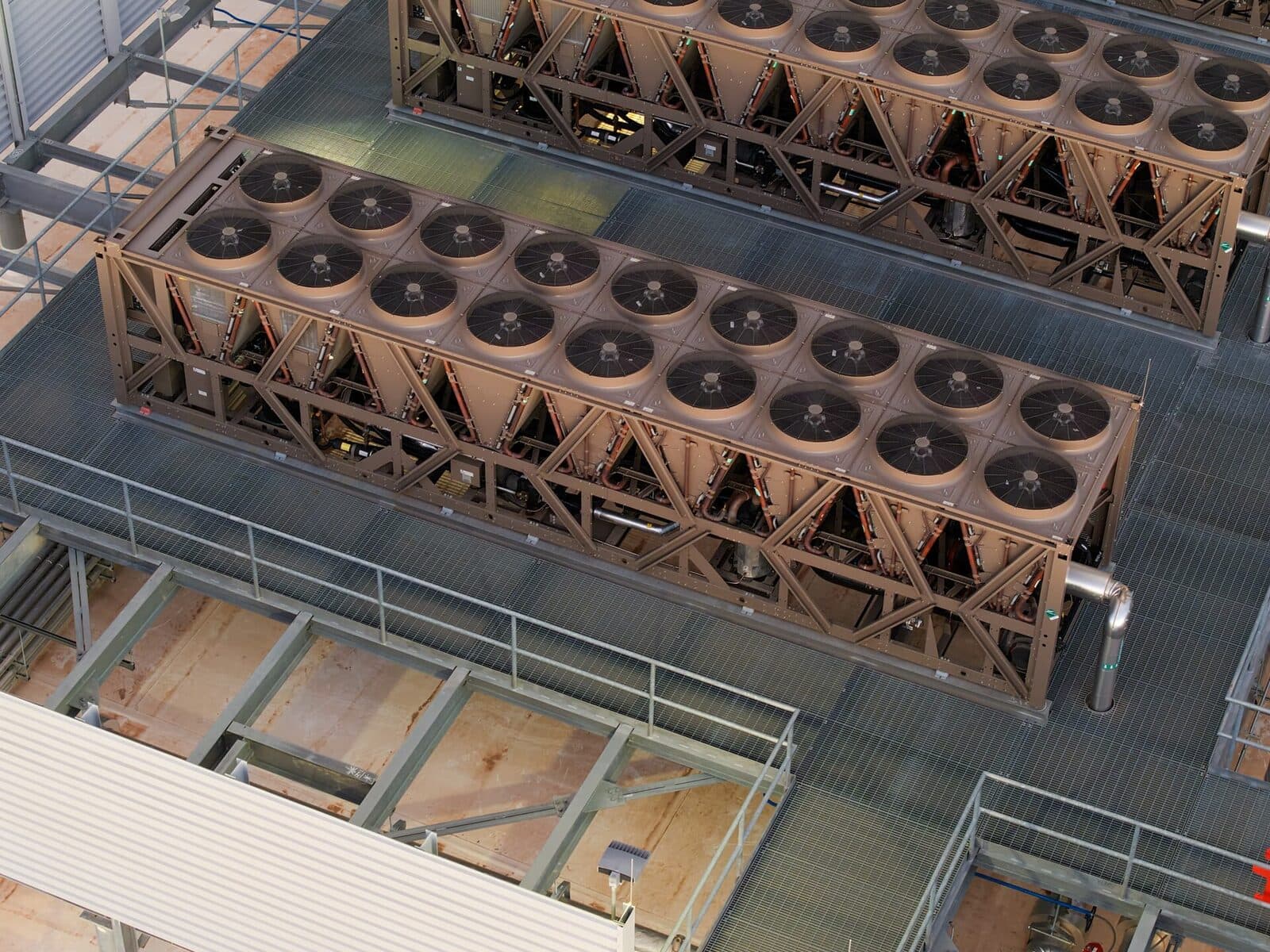
Servers and accelerators turn electricity into computing work and heat. That heat must be removed continuously for the equipment to stay within its operating limits. In a conventional facility, air flows through server racks; cooling equipment transfers heat to chilled-water loops and, in some designs, cooling towers release it to the atmosphere through evaporation.
Evaporation can remove heat with less electricity than some mechanical alternatives, depending on the climate and design. But water that becomes vapor is no longer immediately available in the local basin: it counts as consumption. Systems may also discharge water to control minerals and treat the supply. Other facilities use outside air for more hours, dry cooling, hybrid systems or reclaimed wastewater instead of potable water. The label “water-cooled data center” alone does not reveal how much is withdrawn or consumed. (U.S. Department of Energy technical guidance)
Water withdrawal and consumption are different
Water withdrawal is the volume taken from a surface-water or groundwater source for use. Water consumption is the portion withdrawn that is not immediately returned to the same local availability—for example, because it evaporates, becomes part of a product or leaves the basin. Definitions and return periods matter: water taken and later returned at a higher temperature is not automatically the same as water consumed. (USGS glossary)
Using “consumption” for every liter entering a facility confuses two indicators. One data center may withdraw a large volume and return some of it; another may withdraw less but evaporate a larger share. It may use potable, surface, groundwater or treated wastewater. To understand impact, we need the source, amount withdrawn, amount consumed, amount returned and location. Replenishment is a separate accounting: funding water-restoration projects does not mean a facility physically used no water.
Direct and indirect water: two different pathways
Direct or on-site water is used in data-center operations, mainly for cooling and humidification. Indirect or off-site water is associated with producing the electricity a facility uses: thermoelectric plants may require cooling, while reservoirs can lose water through evaporation. The generation mix, technology and region all change this intensity.
LBNL estimated that U.S. data centers’ electricity use was associated with about 800 billion liters of indirect water consumption in 2023, alongside 66 billion liters of direct facility consumption. The comparison shows how looking only at the building can miss a relevant pathway; it does not turn either figure into an AI-only footprint. The report notes that electricity-related factors vary by region and that its calculation did not include individual power-purchase agreements or behind-the-meter generation.
Training a model and using it are different
Training—and later fine-tuning—uses large batches of computation to create or adapt a model. Inference is subsequent use: answering a question, summarizing text or generating an image. Water used for a training run cannot be divided among queries as if each inherited a fixed share: a model may serve millions of requests, be updated, run in different regions and share hardware with other workloads.
The academic study by Pengfei Li, Jianyi Yang, Mohammad A. Islam and Shaolei Ren modeled GPT-3, a 175-billion-parameter model. Using energy data, reported Microsoft data-center efficiencies and electricity assumptions, it estimated about 700,000 liters of direct water consumption for training and roughly 5.4 million liters when operational water associated with electricity was included. This is an estimate for one GPT-3 training run, not a meter reading or a figure for today’s models. The authors also modeled medium-sized requests; these were not measurements of today’s ChatGPT. (original study by Li and co-authors)
Where the famous “bottle of water” figure comes from
The bottle metaphor mainly comes from the academic paper *Making AI Less “Thirsty”*, first posted as a preprint in 2023 and later published in *Communications of the ACM*. For a medium-sized GPT-3 conversation task, the study estimated about 500 milliliters for every 10–50 responses, depending on when and where the model ran. The figure combined direct cooling water and indirect electricity-generation water under stated assumptions. The authors modelled a medium conversation as up to 800 input words and 150–300 output words, using location-specific Microsoft data-center and electricity-water assumptions. They did not measure current ChatGPT sessions or include water embodied in hardware manufacturing. (academic paper behind the bottle estimate)
That does not mean half a liter per question, or establish what every query uses in 2026. The model was GPT-3; per-request energy, hardware, location and efficiencies do not automatically represent today’s services. Conversely, a measurement from a company such as Google does not invalidate the study: the object, year, service and boundaries differ. Viral summaries erase those caveats when they turn a range for a conversation into a fixed rule per prompt.
Why location, climate and time change the result
With evaporative towers, outdoor temperature and humidity affect how much water must evaporate to release heat. In mild climates, outside air may work for more hours; during hot or humid periods, cooling demand can rise. The same design and workload therefore need not use the same amount of water throughout the year. Local scarcity matters too: the same volume can have different consequences in a basin with plentiful supply and one under water stress.
If electricity generation is included, the footprint also varies by region and hour: marginal power may come from technologies with different water needs. WRI Aqueduct’s water-stress indicator compares total withdrawals with available renewable water; it signals competition for a resource, not damage caused by one specific data center. A national average cannot replace basin-, source- and season-specific information. (WRI Aqueduct methodology)
What major technology companies disclose
Corporate reports help show trends, but their boundaries differ, and data-center water usually covers cloud and other services as well as AI. Google said its projects replenished about 7.7 billion gallons in 2025, equal to 78% of its total freshwater consumption under its corporate methodology. This is company-wide replenishment; it does not show that its data centers or AI consumed no water. (Google 2026 Environmental Report)
AWS reported a global data-center WUE of 0.12 liters withdrawn per kWh of IT load in 2025, an intensity metric the company defines in terms of withdrawals. Microsoft reported a 23% year-over-year reduction in WUE at its Phoenix data centers in fiscal 2025 and said it replenished more water than it withdrew globally in FY2025. These figures use different scopes and metrics; they are not a common league table and should not be attributed entirely to AI. (AWS sustainability data; Microsoft sustainability report)
“Water positive” or replenishment targets seek to return or restore to watersheds a volume equivalent to or greater than the company’s measured use, under its chosen rules and through projects. They may fund leak repairs, treatment, restoration or agricultural efficiency. Such work can matter locally, but it does not erase a site’s physical consumption or by itself guarantee the water returns to the same basin, source or time period.
WUE and cooling: less water can require more electricity
WUE (Water Usage Effectiveness) relates a facility’s water use or consumption to the energy used by its IT equipment; it is commonly expressed in liters per kilowatt-hour. ISO/IEC 30134-9 defines WUE as an indicator of data-center water consumption during the use phase. Company reports may use a withdrawal-based variant, so the definition must be checked before comparing. WUE is not “liters per AI” and does not by itself describe local scarcity. (ISO/IEC 30134-9 standard on WUE)
PUE measures something else: total facility energy divided by IT equipment energy. A value closer to 1 means less relative supporting energy, but neither PUE nor WUE alone summarizes local impact, electricity mix or total volume. Direct-to-chip liquid cooling carries fluid to components and can use a closed loop: liquid circulates and is reused while heat is rejected in a later stage. “Liquid cooling” does not mean that new water is continually consumed.
There can be a water–electricity trade-off. An evaporative tower may consume water on site while requiring less electricity to cool; a dry or air-cooled system may reduce direct consumption and require more power in some conditions. Hybrid designs switch methods as temperature, humidity and load change. No single option works everywhere: direct and indirect water, electricity and basin conditions should be assessed together.
What about water used to make chips?
Semiconductor manufacturing uses ultrapure water to clean and process wafers, as well as energy and chemicals. That footprint belongs to the accelerator and server supply chain, not daily data-center cooling. Public information does not let us consistently assign manufacturing water to each model or query, so it is excluded from the main figures. Including it would broaden the analysis to life-cycle accounting and require a different inventory.
When does water use become a problem?
A global total is not enough. Communities need to know the basin, season, water quality, whether the source is potable or treated wastewater, existing rights and uses, supply capacity and the effect of withdrawals during dry periods. A large facility can create local pressure even if its volume is small compared with national use; conversely, a global figure alone cannot establish a local crisis.
Useful transparency would publish, by facility and period, withdrawal, consumption, return flow, source and water quality, cooling method, WUE and calculation boundaries; for electricity, it would disclose the regional water-intensity factor used. Where measurement permits, it would also distinguish data centers from AI workloads and report weather or design changes. Metrics need to remain comparable so an efficiency gain does not hide growth in total volume.
So how much water does AI use?
The rigorous answer is neither “none” nor “a bottle per prompt.” AI has an operational water footprint: some data centers consume water in their cooling systems, and the electricity they use can be associated with off-site water consumption. Documented cases and estimates exist, but there is no fixed factor that describes every service, model, location and query.
To understand the impact, ask where and when the workload runs, where the water comes from, how much is withdrawn and consumed, what cooling and electricity are used, and whether the area is water-stressed. The expansion of data centers and its economic implications are covered in our article on AI infrastructure investment. These questions recognize a real cost without turning a contextual estimate into a slogan.
Frequently asked questions
How much water does a ChatGPT question use?
There is no universal public figure or comparable official OpenAI measurement per query. It depends on the model, response, data center, cooling and whether electricity-related water is counted. The half-liter figure usually comes from an estimate for 10–50 medium GPT-3 responses, not one current question.
Does ChatGPT use water directly?
The software itself does not use water. Its computing infrastructure may withdraw and consume water for cooling; electricity generation can add indirect consumption. Direct use depends on the data center and its thermal system.
Does liquid cooling use more water?
Not necessarily. Liquid can circulate in a closed loop and be reused. What matters is how heat is ultimately rejected and whether evaporation, blowdown or water replacement occurs. Liquid cooling describes heat transfer, not by itself the volume of water consumed.
Which uses more water: training or using AI?
There is no universal ratio. A training run can concentrate a great deal of energy into a period; inference repeats whenever the service is used, and its cumulative impact depends on query volume and serving methods. Available studies use different models and boundaries, so they do not support a general rule for every system.
Related guides

Technology
Is there an AI bubble? The global race to build data centers
Big tech is accelerating data-center, chip and grid construction. Here is what companies hope to earn back, and what could show that they are building too much.
13 min read
Technology
The 5 best web browsers of 2026: privacy, security and features compared
Compare Chrome, Firefox, Edge, Brave and Safari by privacy controls, security features, compatibility and everyday use.
11 min read
Technology
How to back up Android: Google, photos and files step by step
Learn how to back up Android with Google, save photos and files, transfer data and check what can be restored.
11 min read