
How to Decorate a Christmas Table: Easy and Elegant Ideas
A practical guide to setting and decorating a Christmas table: colours, tablecloth, tableware, napkins, low centrepieces, safe candles and ideas for small tables and tight budgets.
By TopicWeekPublished 14 min read

In this article
A beautiful Christmas table is, above all, a table where people eat comfortably. The effect depends less on how many decorations you add than on a few decisions: a short colour palette, a tablecloth or runner that suits the tableware you already own, well-presented napkins, a low centrepiece that doesn't hide anyone, warm light, and free space for serving dishes and glasses. This guide goes through them in order, with options for formal dinners, family meals and small tables.
Before you decorate: guests, space and budget
Decorations adapt to the real table, not the other way round. Before you bring out any decorations, answer these questions:
- How many people are sitting down? Set all the plates and chairs first; whatever table is left over is the space to decorate.
- How is the food served? If dishes come to the table, keep a clear strip down the middle or at one end; if you serve from the kitchen, the centre can take more decoration.
- What plates, cutlery and glasses do you have? Count per guest before choosing a style; it's easier to match colours to your tableware than the reverse.
- What textiles and decorations are already at home? Tablecloths, napkins, spare tree baubles, ribbons and trays are often enough.
- How much do you want to spend? Decide a figure and a list of what's genuinely missing (napkins or LED candles, for example) before going shopping.
- Are there young children or pets? That affects candles, small decorations and the length of the tablecloth.
Choosing colours for a Christmas table
Choose a main colour, a supporting colour and, if you like, a metallic accent. No combination is better than another; the one that works best is usually the one that suits your tableware. Here's how to spread them across the table:
- Red and gold: a light or red tablecloth, red napkins, white plates and touches of gold on chargers, cutlery or napkin rings; a green centrepiece with some red.
- White and gold: a white or cream tablecloth, white plates, gold chargers or cutlery and a green centrepiece; this is the combination in the cover photo.
- Green and wood: a bare wooden table or linen cloth, green napkins, branches and pine cones in the centre, white or earthenware plates.
- White and silver: a white tablecloth, clear glassware, silver decorations in the centre and grey or white napkins.
- Natural tones: undyed linen, beige napkins, wood, kraft paper and a single green sprig at each place.
- Mixed colours: if your plates come in several colours, tie them together with a plain tablecloth and matching napkins for everyone.

How to choose the tablecloth and table runners
The textile sets the tone of the table and protects the wood from heat and stains. The most common options:
- Full tablecloth: the most formal and the most protective; choose one that hangs without trailing on the floor, ironed or at least free of hard creases.
- Table runner: a strip down the middle of a bare table or over a plain cloth; it adds colour without covering everything.
- Placemats: practical for informal meals and easy to wash; they mark each guest's place.
- Bare wooden table: suits a natural style, but use trivets under hot dishes.
- Layers: a plain cloth with a runner on top, or a cloth with placemats, adds depth without buying anything new if you already own the pieces.
- With young children: avoid long drops of tablecloth they can grab and pull; a cloth that fits the table or placemats are better.
- Reuse: a plain sheet or a clean piece of curtain fabric can be a tablecloth; a tartan scarf, a runner.

How to combine tableware, cutlery and glassware
You don't need a special dinner service: consistency comes from repeating the same setting at every place. Practical guidelines, not compulsory etiquette:
- A common base: if your plates differ, put the same charger, placemat or napkin underneath to tie them together.
- Charger: it's decorative and acts as a base for plates that are changed between courses; use it for multi-course dinners, skip it for informal meals.
- Plates for the menu: set only those you'll use; a soup plate on top of the dinner plate if there's soup, a dessert plate brought out at the end.
- Functional cutlery: forks on the left and knife and spoon on the right is a common layout; set only what the menu needs.
- Glasses: one for water and one for each drink you plan to serve, to the right above the knife; if you don't have matching wine glasses, use identical simple glasses for everyone.
- Mixing with order: combine different pieces while keeping one colour or material in common (for example, all white with gold cutlery).
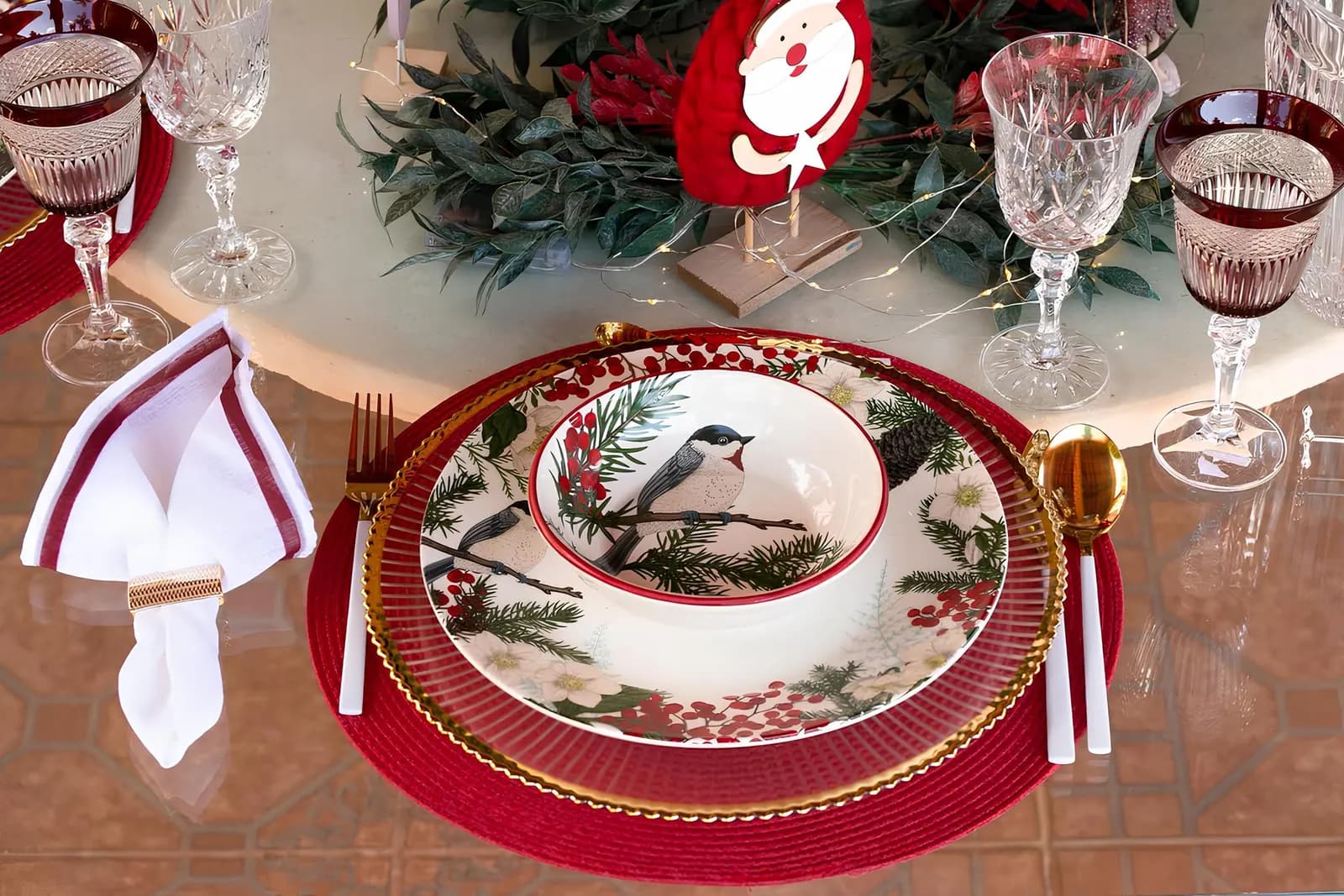
How to place and decorate Christmas napkins
The napkin is the cheapest decoration on the table. Some simple ways to present it:
- On the plate, folded into a rectangle, with a sprig or a name tag on top.
- With ribbon or string: roll the napkin and tie it with a ribbon in the table's colour.
- With a napkin ring: ones you already own, or a loop of string with a small pine cone.
- Cloth or paper: cloth is reusable and more elegant; paper suits a big meal or one with children, and festive printed paper napkins are available.
- Clean decorations: don't put anything on the napkin that sheds glitter, dye or resin, or pieces that could fall onto the plate.
Simple pocket fold for cutlery
- Start with a square cloth napkin, ironed, wrong side up. Fold it in half and in half again: you get a smaller square with all four loose corners at one corner.
- Turn the square so the loose corners are at the top right. Fold only the top layer diagonally down to the bottom-left corner and flatten it: you'll see a diagonal band.
- Turn the napkin over and fold a third of the left side and a third of the right side backwards, so you get a narrow rectangle.
- Turn it back over and place it on the plate or to the left: the diagonal band forms a pocket for the cutlery or a sprig.

Christmas centrepieces: how to choose the right one
The centrepiece is the star, but it mustn't get in the way. Before choosing one, check these points:
- Height: guests should see each other over or through it; a low centrepiece (roughly below seated eye level) or a tall, slender one works.
- Shape and size: long for rectangular tables, round for round tables, with free space on either side for dishes.
- Stability: a wide base and nothing that tips over when a dish is passed.
- Easy to move: on a tray, so you can lift it away whole if you need the space.
- No candles, or candles away from anything that burns: see the candles section.
- Materials: branches, pine cones, baubles, whole fruit or ceramic decorations; neither branches nor decorations are suitable for touching food, and some plants aren't safe for pets.
- Ideas: a low garland of greenery along the table, a tray of baubles and pine cones, a bowl of whole fruit, three LED candles at different heights or a single low vase.
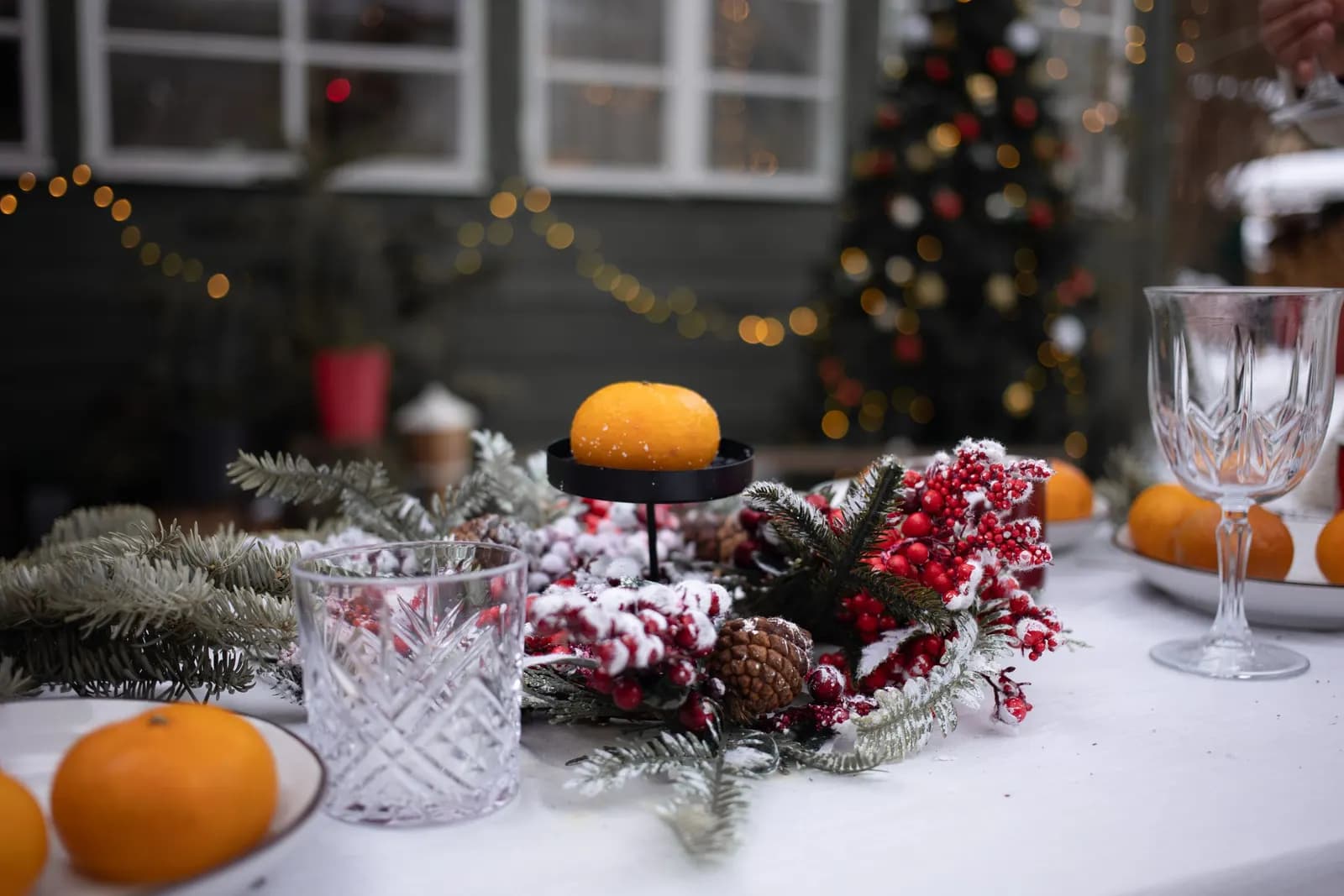
How to make an easy, inexpensive Christmas centrepiece
This centrepiece takes a few minutes with things most homes have. You need a stable tray or bowl, shatterproof or spare tree baubles, some branches or dry pine cones and, if you want light, LED candles.
- Prepare the base: choose a wide, stable tray or bowl that will only be used for decoration (don't serve food from it unless it's made for food); if the surface is slippery, put a trivet or a cloth underneath.
- Place the big items first: group the largest baubles in the middle of the base without stacking them high.
- Fill in: add small baubles, pine cones and sprigs in the gaps; mix matt and shiny finishes. If young children are at the table, use shatterproof baubles and avoid tiny pieces.
- Fix if needed: if something rolls, hold it with a little tape under the tray or a clip; don't glue anything onto plates or dishes that will be used for food.
- Add flameless light: place LED candles in the middle or around it, instead of lit candles among the branches; check that the battery covers are firmly closed.
- Check: push the tray gently to see that nothing falls and make sure it's low enough to see across. On a small table, use a bowl instead of a long tray.

Candles and lighting for the Christmas table
Warm light gives a table more atmosphere than anything else, but candles are an open flame next to textiles, paper and greenery. Some guidelines:
- LED or flameless candles are the simplest choice when the centrepiece includes branches, paper or fabric, or when children or pets are nearby.
- If you use lit candles, the US NFPA recommends keeping them at least 12 inches (30 cm) from anything that can burn and blowing them out before leaving the room; it's a minimum guideline, not a guarantee.
- Stable holders: wide, heavy and not likely to tip if the table is knocked; tall thin candles are less stable.
- Never unattended: the CPSC advises never leaving candles unattended and using flameless candles whenever possible.
- Spread the light: several small LED candles along the table plus warm room lighting work better than one big candle.
- LED candles and battery lights: use them as the manufacturer instructs and watch the battery compartment if there are children (see below).
Christmas table ideas by style
Five complete looks you can adapt to your tableware:
- Traditional: white or red tablecloth, white plates on gold chargers, red napkins with a sprig, a low centrepiece of greenery with red baubles and LED candles.
- Minimalist: a bare table or plain grey cloth, one plate and two pieces of cutlery per person, a pine sprig on each plate and a single item in the centre.
- Natural: a linen runner, beige napkins tied with string, pine cones and dry branches in the centre and paper or wooden houses as place cards.
- Elegant: a pressed white tablecloth, clear glassware, gold or silver cutlery and one accent colour repeated in the napkins and centrepiece.
- Informal or family: placemats or a washable cloth, festive paper napkins, serving dishes on the table and decoration only at the ends.
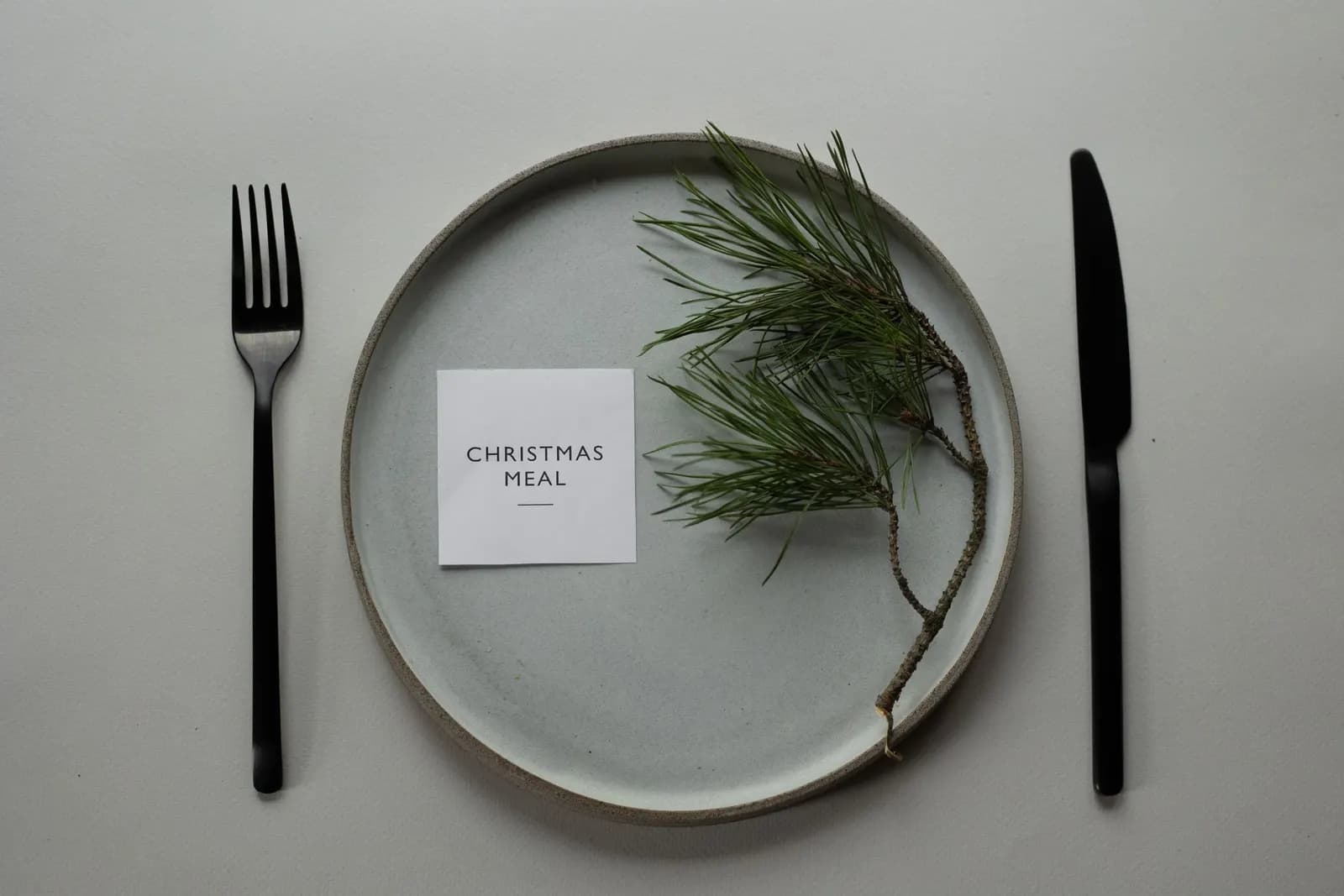
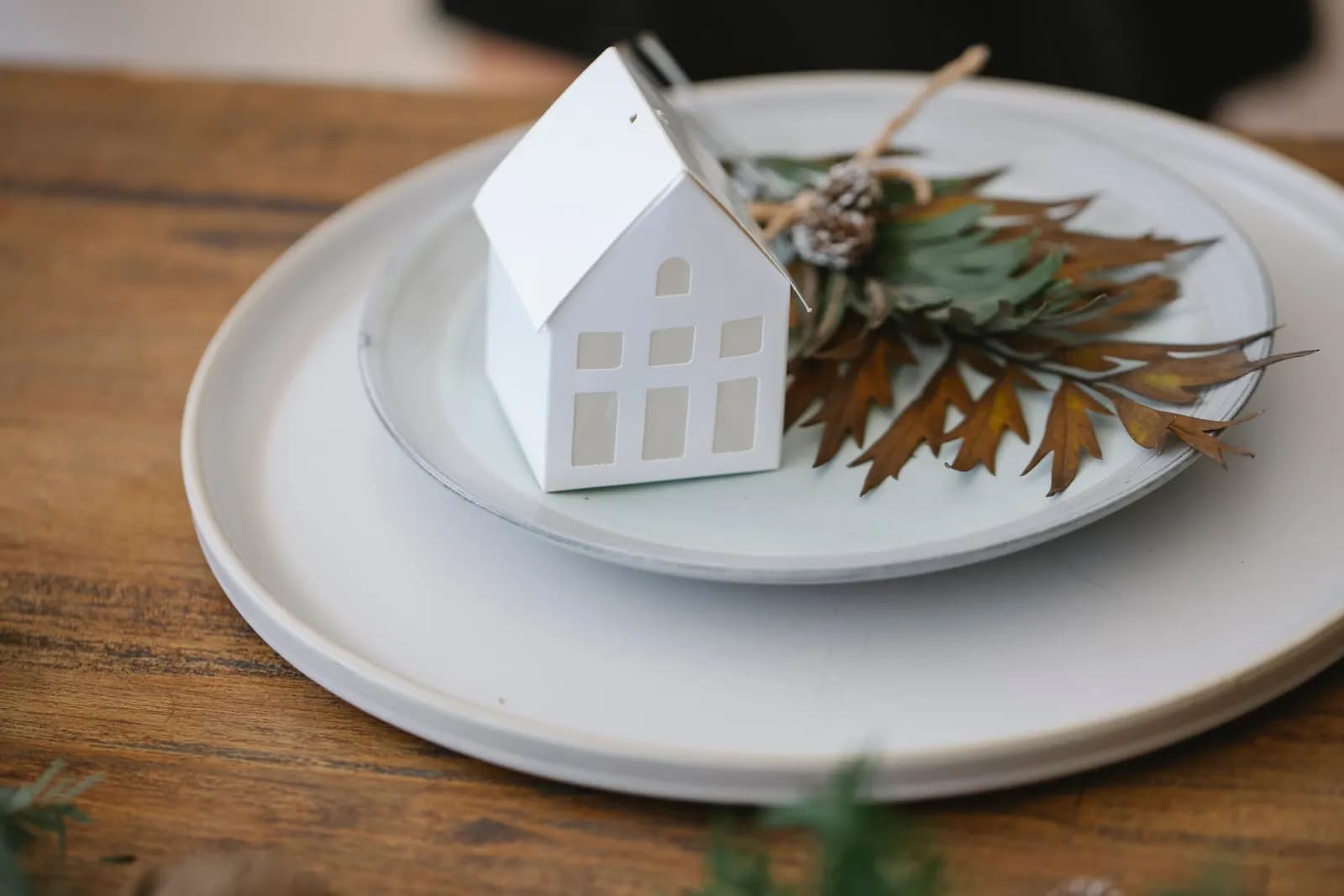
How to decorate a small table for Christmas
On a small table, plates, glasses and dishes come first; decoration fills whatever is left. If your whole home is small, our guide to Christmas decorating ideas for small spaces has more space-saving ideas.
- A low, compact centrepiece (a bowl, an LED candle or a sprig in a glass), or none if the food goes in the middle.
- Decorate the places: a sprig or a special napkin on each plate replaces the centrepiece.
- A movable tray: gather salt, pepper and decorations on a tray that comes off when the dishes arrive.
- Simple textiles: a narrow runner or placemats, with no long drops getting in the way of legs.
- Nothing tall: tall candlesticks and vases take space and block the view.
- Dishes elsewhere: serve from a sideboard or the kitchen if they don't fit on the table.

How to decorate a Christmas table on a budget
The most striking tables aren't usually the most expensive, but the best organised. Decisions that genuinely save money:
- Use the tableware you have and tie it together with a tablecloth or matching napkins.
- A two-colour palette makes mismatched pieces look chosen on purpose.
- Reuse textiles: tablecloths, plain sheets, fabric or scarves as a runner.
- Build the centrepiece from tree decorations, pine cones, fallen branches or whole fruit.
- Don't buy “Christmas” cutlery or plates you'll use once; if anything, invest in cloth napkins or LED candles that will serve in other years.
- Choose decorations that store well and note them down for next year.
- Buy only what's missing from your list; prices vary by country and shop, so we don't give figures.

If you want to plan your overall holiday spending, our guide on how to make a personal budget from scratch helps you decide how much to set aside for the table. To decorate the rest of the home in the same spirit, see how to decorate your home for Christmas.
How to set a Christmas table with children or pets around
Precautions depend on the children's ages and the animals at home. General guidelines:
- Stable decorations away from the edge, especially where children sit.
- No small parts within reach: the CPSC recommends keeping small parts away from children under three.
- No delicate glass at the children's end; sturdy tumblers are better.
- LED candles instead of lit ones, or candles only at the adults' end and always supervised.
- Button batteries: many LED candles and lights use them. The CPSC warns that a swallowed battery can burn through a child's oesophagus in as little as two hours; use products with screw-secured compartments, remove any with a damaged cover and, if you suspect one has been swallowed, seek urgent medical help.
- A fitted cloth or placemats, so nobody pulls it.
- Pets: the UK's RSPCA warns that tinsel, baubles and ribbons can cause blockages if swallowed, that scented candles can be toxic, and that plants such as poinsettia, holly, mistletoe, ivy and lilies can cause problems; the risk depends on the animal and the amount. A natural decoration isn't automatically safe.
Common Christmas table decorating mistakes
- A centrepiece that's too tall: lower it or use a slim one that lets people see each other.
- Too little room for plates: set the places first and decorate whatever space is left.
- Too many decorations: limit the palette and leave some areas clear.
- Uncomfortable textiles: cloths that drag or runners that snag; fit them to the table.
- Unused pieces: don't set glasses or cutlery the menu doesn't need.
- Candles near anything that burns: use LED or keep them away from greenery, paper and fabric.
- Unstable decorations: wide bases and nothing that rolls.
- Small parts within children's reach: move them up or remove them.
- No room to serve: keep space for dishes or serve from another surface.
- Buying too much: decorate with what you have first.
Decoration safety and hygiene
The table brings food, heat and decorations together in a small space. Before sitting down, check:
- Food and decorations apart: no non-food decorations (branches, pine cones, baubles, glitter, paper) directly on food or inside serving dishes; if you want to decorate a plate, put the decoration to one side or on a base.
- Containers suitable for food: serve food on tableware and dishes made for food; a decorative bowl or tray isn't suitable by default. In the European Union, materials intended to come into contact with food must comply with Regulation (EC) No 1935/2004 and often carry the glass-and-fork symbol; other rules apply outside the EU.
- Glitter and decorative dusts: the US FDA advises against putting them on food unless they're made to be edible: a label saying “non-toxic” or “for decorative purposes only” doesn't mean edible. If a cake carries a non-edible decoration, remove it before serving.
- Loose bits: avoid decorations that shed needles, glitter or feathers that could fall into plates and glasses.
- Hot dishes: leave room and trivets for dishes straight from the oven, away from paper or fabric decorations; a tablecloth or runner doesn't protect against heat.
- Fragile glass and ceramics: set firmly and away from the edge.
- Candles: never unattended, and blown out before clearing up.
- Plants: keep them out of contact with food and out of pets' reach if they may be toxic to them.
Frequently asked questions
How can I decorate an elegant Christmas table without spending much?
Tie your existing tableware together with a plain tablecloth and matching napkins, limit the palette to two colours and a metallic, and build a low centrepiece from tree decorations, branches and LED candles. Elegance comes from order and repetition, not price.
What colours work on a Christmas table?
Red and gold, white and gold, green and wood, or white and silver are easy combinations. Choose the one that suits your tableware and repeat it in the napkins and centrepiece.
What should go in the middle of a Christmas table?
Something low and stable: a greenery garland, a tray of baubles and pine cones, a bowl of whole fruit or several LED candles. If dishes go in the middle, a small centrepiece you can lift away is better.
How do I decorate a table without a tablecloth?
Use a table runner or placemats, cloth napkins and a centrepiece on a tray. Protect the wood with trivets under hot dishes.
How do I set a simple Christmas table?
Matching plates or plates tied together by one napkin, a sprig on each plate, a low centrepiece and LED candles. That's enough for a festive table with room to eat.
Sources
- NFPA (United States): Candle safety.
- CPSC (United States): Holiday Safety and button cell batteries.
- RSPCA (UK): Christmas dangers for pets.
- FDA (United States): non-edible decorative products on food.
Related guides

Home
How to Decorate Your Home for Christmas: Easy, Beautiful and Budget-Friendly Ideas
Room-by-room ideas to decorate your home for Christmas without spending much: living room, entryway, windows, shelves, bedroom and kitchen, plus simple crafts and safety.
15 min read
Home
Christmas Decorating Ideas for Small Spaces: Practical Ways to Save Room
How to decorate a small flat, studio or single room for Christmas without losing space: compact and wall trees, vertical decor, renter-friendly ideas and decorations that store easily.
15 min read

Home
How to Paint a Room Step by Step: Materials, Preparation and Common Mistakes
Plan materials, prepare walls, estimate paint quantity and apply it safely with a roller and brush. Includes drying times, common mistakes and a worked example.
11 min read