
How to make a personal budget from scratch and keep it on track
Learn to organize available income, fixed and variable expenses, plan periodic bills and review a monthly budget with clear examples.
By TopicWeekPublished 8 min read
In this article
A personal budget is a plan for how to use money over a period. It can help make income, bills and priorities visible, but it cannot create money or guarantee savings. A useful plan reflects a person’s actual resources and obligations; there is no percentage split that works for everyone.
For free educational examples of budgeting steps, compare resources from Finanzas para Todos, the U.S. CFPB and UK MoneyHelper. Their guidance reflects their own audiences and is not a universal rule.
What a budget can and cannot tell you
A budget, a spending record and a bank balance are related but different. A budget plans intended uses; a record captures what was paid; a balance is what an account shows at one moment. Cash flow also considers when money arrives and when bills fall due. Start with the simplest system you can maintain: paper, a notebook or a spreadsheet can work.
1. Work out available income
Use money actually available for the period. For an employee, this usually means take-home income after deductions, not gross pay. For self-employment, invoices are not automatically spendable: consider business costs, taxes or contributions that apply to your circumstances and uncertain payment dates. Keep confirmed, expected and uncertain income separate. Treat a one-off payment separately rather than building recurring costs around it; revise estimates when real receipts differ.
Depending on your situation, income records may include wages, recurring payments, self-employment receipts after relevant costs, benefits or other regular sources. Use a consistent period and avoid counting the same money twice. For variable work, past receipts can inform an estimate, but they do not guarantee the next payment.
2. Record spending and obligations
Record actual spending from statements, receipts or notes over a representative period. Frequency and purpose are separate classifications: rent may be fixed and essential; groceries can be necessary but variable; a subscription can be fixed yet discretionary. Do not assume every variable cost is optional or every fixed payment is essential. Possible categories include housing, utilities, food, transport, health, insurance, communications, education, family costs, debt obligations, leisure, subscriptions and future goals. Use the categories that fit your household. For debts, list required minimum payments and due dates; decisions about additional payments depend on the agreement and circumstances.
If possible, review several recent months so that quarterly, annual or seasonal costs are less likely to be missed. If you do not have records, start with what you know, mark uncertain amounts as estimates and improve them as you collect actual data. Do not change what you record simply to make a target rule appear to fit.
Plan for known costs that are not monthly
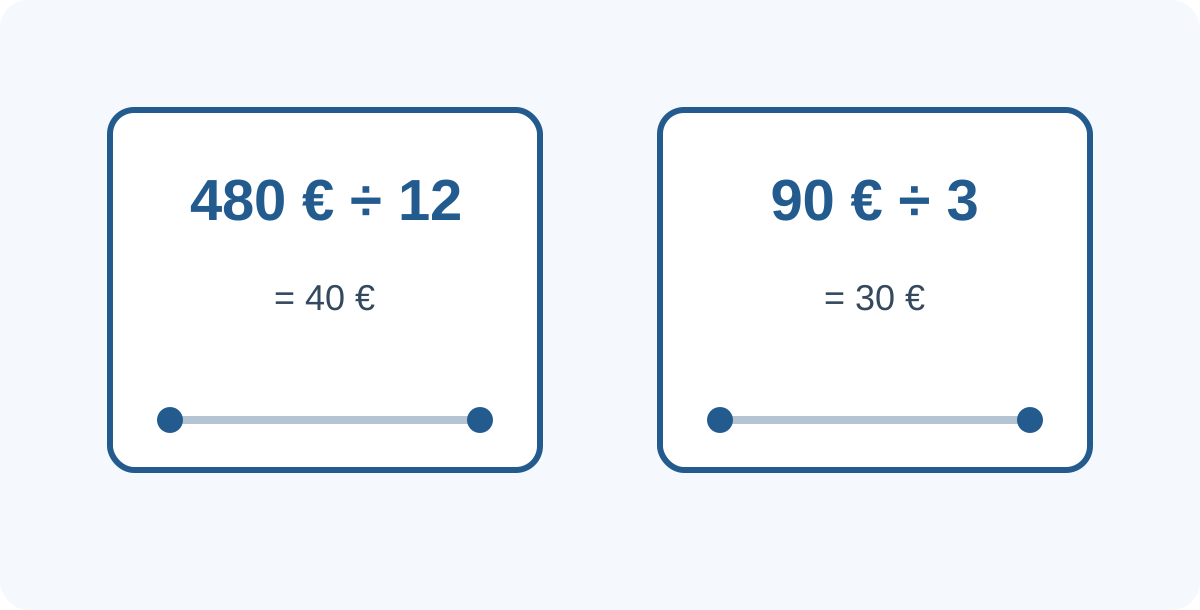
Known costs that do not arrive monthly still belong in the plan. A hypothetical annual bill of €480 spread across 12 months is €40 per month (480 ÷ 12 = 40). A quarterly €90 bill spread across three months is €30 per month (90 ÷ 3 = 30). These are planning allocations; they do not mean the provider accepts instalments. If the bill is due sooner, divide by the actual time remaining and account for money already set aside. A known annual bill is not an unpredictable emergency, though its exact amount may vary.
A true unexpected cost has an uncertain timing or amount. A separate margin for such costs may help if resources allow, but this guide does not prescribe a universal reserve amount.
When you set money aside for a known bill, treat that amount as committed rather than available for another category. When the bill is paid, record the payment once: do not count both the original monthly set-aside and the later payment as two separate costs in the same total.
3. Choose a budgeting method
Choose a method you can keep using. Category budgeting assigns flexible amounts to groups of spending. Zero-based budgeting gives every unit of available income a planned purpose—including bills, known future costs, savings or a buffer—so the planned remainder is zero; it does not mean spending everything or emptying a bank account. Envelope budgeting separates category limits using physical envelopes or a written/digital record; carrying cash or opening extra accounts is not required. No method is best for everyone.
The 50/30/20 approach is often described as 50% for needs, 30% for wants and 20% for savings or financial goals. The CFPB teaching guide bases its example on net income and says not everyone can follow it; definitions differ, especially around debt payments. The arithmetic totals 100%, but this is only an optional reference, not a legal or scientifically optimal target. High essential costs or irregular income may make it unrealistic. Do not leave basic needs unpaid to fit a percentage.
A worked monthly example
Hypothetical monthly plan for €2,000 of net available income. The figures illustrate arithmetic, not average costs or a recommended allocation; apply the method in your own currency without converting these examples.
- Housing: €800; utilities: €160; food: €320; transport: €120.
- Required minimum debt payments: €150; provision for known non-monthly costs: €180.
- Discretionary spending: €170; a future goal, if affordable: €100.
- Total assigned: €2,000. The €180 is earmarked for future bills, not free spending. The €100 is assigned to a goal; it is not proof that the amount has already been saved.
4. Compare the plan with reality
Compare the plan with what happened. If a category was budgeted at €250 and actual spending was €285, the difference is 285 − 250 = €35. Check whether the estimate, timing or circumstances changed and adjust the next plan. A first budget need not predict every amount accurately.
When the numbers do not balance
If income is €1,900 and estimated costs and obligations are €2,030, the difference is 1,900 − 2,030 = −€130. Check for missing entries and dates; record income and due dates. Review discretionary costs where there is genuine room and find out whether an obligation can be discussed. Do not assume small cuts can close a gap in essential costs, ignore obligations or take new credit as an automatic fix. A negative budget can reveal a real shortfall of income against essential expenses; depending on location, suitable public or non-profit advice may be available. A monthly total can also conceal a timing problem if a bill is due before income arrives.
Variable income and cash-flow timing
For changing income, build an initial plan around confirmed resources and update it when actual receipts arrive. Reviewing a lower-income month is one budgeting approach described by MoneyHelper in the UK, not a universal formula. Record both expected income dates and bill due dates. A monthly plan can add up while cash is unavailable on a particular day.
Tools, privacy and regular review
A spreadsheet can use columns for item, category, planned amount, actual amount, date or period and difference. Digital tools are optional; do not share account passwords. A household budget should reflect agreed responsibilities and circumstances, not require access to another person’s accounts. Treat statements, screenshots and account details as sensitive, especially on shared or public devices.
If several people share household costs, agree which bills and amounts belong in the shared plan and which remain individual. Include dependants or joint commitments where relevant, while respecting each person’s circumstances. A shared budget is a coordination tool, not a reason to demand someone else’s banking credentials.
At a regular review, check income received, payments made, upcoming periodic costs and differences from the plan. Adjust categories and dates for the next period. Monthly review suits many monthly pay cycles; changing income or due dates may call for another rhythm. Include savings goals only when resources allow after considering current obligations and liquidity. Savings are a planned destination, not a reason to miss essential payments.
- Check income actually received and payments made.
- Compare planned and actual amounts; note the difference without treating it as a personal failure.
- List upcoming known periodic costs and due dates.
- Adjust estimates and categories for the next period; protect essential payments and current cash needs.
- If income or bill dates change, review the cash-flow plan again rather than waiting for month-end.
If a planned amount remains at the end of the period, first check which upcoming bills or commitments it was meant to cover. Then decide whether to carry it forward, assign it to another known cost or goal, or revise the next estimate. A positive balance is not automatically free to spend if payments are still due.
Four hypothetical situations
- Hypothetical: a salaried worker records real spending first, then chooses a few categories to plan; no standard percentage is required.
- Hypothetical: a freelancer separates confirmed receipts from uncertain invoices and revises allocations as money arrives.
- Hypothetical: a household notes a known annual bill, its due date and time remaining before choosing a monthly set-aside.
- Hypothetical: essential costs exceed income. The budget makes the shortfall visible; it does not mean the person lacked discipline. Check figures and timing and seek suitable local support if needed.
A first-budget checklist
- Have I separated available income from gross pay and uncertain receipts?
- Have I listed actual spending, required payments and due dates?
- Have I kept frequency separate from whether an expense is essential or discretionary?
- Have I included known annual and quarterly costs, with the real due date?
- Do the totals and timing fit expected cash flow?
- Have I chosen a method I can maintain and protected sensitive records?
- Have I included savings goals only if resources permit?
Common myths and questions
- Variable expenses are always optional: false; food can vary and still be necessary.
- Fixed expenses are always essential: false; a subscription can be fixed and discretionary.
- Zero-based budgeting means spending everything: false; savings and future costs can be assigned.
- The first budget must be exact: false; review and adjustment are part of the process.
- Everyone can save the same share: false; resources and essential obligations differ.
- Do I need an app? No. Paper or a spreadsheet can be enough.
- Should I follow 50/30/20? Only if it helps as a flexible reference; it is not a universal target.
- What if income changes each month? Separate confirmed from uncertain amounts and update the plan when income arrives.
- What if expenses exceed income? Check figures and dates, consider realistic changes and suitable local advice; a budget alone cannot solve insufficient income.
- How often should I review? Choose a rhythm that fits income and bills, then compare planned and actual amounts.
Related guides

Money
Credit Card vs. Debit Card: Differences and Which to Choose
Understand how credit and debit cards use money, when interest or fees may apply, and what to check before choosing.
11 min read

Money
How to Pay Off Debt: Snowball vs. Avalanche Method
Compare the debt snowball and avalanche methods with a reproducible example, and learn why priorities, minimums and contract terms matter.
9 min read

Money
ETFs vs. Index Funds: Differences, Costs and How to Compare Them
Indexing and ETF structure are not opposites. This guide compares index-tracking ETFs with traditional unlisted index funds so you can assess trading, costs, tracking and tax in your jurisdiction.
16 min read