
How to book accommodation without surprises: total price, cancellation, payments and scams
A practical guide to choosing and booking a hotel, apartment or holiday home: how to compare the total price, understand free cancellation and deposits, pay safely, spot scams and act if something goes wrong.
By TopicWeekPublished 16 min read

In this article
You find two similar places to stay. One costs €80 a night; the other, €110. But the first adds cleaning and taxes, asks for a deposit and refunds nothing if you cancel, while the second includes breakfast and lets you cancel free of charge until a few days before. The nightly price isn't enough to decide.
This guide explains what to check when booking a hotel, guesthouse, apartment or holiday home, and what to do if something goes wrong. It doesn't recommend any platform and separates what the law says (mainly in the EU) from what depends on each rate.
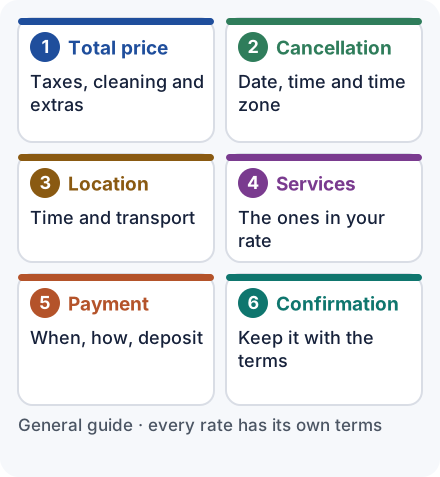
Step 1. Choose the type of accommodation for your trip
No type is always better or cheaper; it depends on your group, the number of nights and what you need. Typical differences, with variations at each property:
- Hotel: reception, frequent cleaning and services such as breakfast or luggage storage; usually less space and no kitchen.
- Guesthouse or small family-run hotel: smaller, simpler places; services and reception hours vary a lot.
- Hostel: beds in shared or private rooms, often with a shared kitchen; less privacy.
- Holiday apartment: a kitchen and more space, useful for longer stays or groups; entry may be by keys or codes and cleaning is often charged separately.
- Holiday home or rural stay: space and independence; check access, transport and whether you'll need a car.
Step 2. Choose the location carefully
A cheap place that's far away can cost you in time and transport. Before looking at the room, put it on a map and check:
- Distance to what you'll actually do, not to the “centre” the listing mentions.
- Public transport: nearby stops, frequencies and the time of the last service if you'll come back at night.
- Arrival and departure: how to get there from the airport or station with luggage.
- Surroundings and access: nearby shops and services, night-time noise, what the area is like when you'll be out, hills and stairs.
- Parking, if you're driving: whether there is any, whether it's paid and whether you need to book it.
If you already have an itinerary, choose the area that keeps your main visits closest; our guide to planning an itinerary explains how to group places by area. Our guides to Rome and Paris include examples of where to stay for each route.
Step 3. Compare the total price, not the nightly rate
The price you see when searching isn't always what you'll pay. In the EU, traders must tell you the total price including taxes and additional charges before you buy, and can't charge extras without your express consent (Your Europe; Directive 2011/83/EU, Art. 6). Even so, some items are paid at the property or depend on your choices. Check, where relevant:
- Taxes and tourist taxes, which some destinations collect separately on arrival.
- Final cleaning, bed linen or towels.
- Breakfast, parking, an extra bed or a cot.
- Supplements for an extra person or a pet.
- A security deposit (not a payment, but it ties up money).
- The currency of the charge and any conversion fees.
Always compare the final amount for the whole stay and add what you'll spend because of where it is (transport, breakfast elsewhere). If the charge is in another currency, compare the amount in both before accepting: Your Europe says paying in the local currency is often the cheapest option and that, if you're offered an on-the-spot conversion, you must be told the mark-up, although the final cost also depends on your bank (Your Europe). To fit it into the total cost of the trip, see our guide to making a travel budget.
Step 4. Check exactly what your rate includes
Services listed on the property's page aren't always included in the room or rate you choose. Read the description of your specific option:
- Number of guests, room type and the number and type of beds.
- Private or shared bathroom, kitchen, breakfast, Wi-Fi, heating or air conditioning.
- Lift, accessibility and parking.
- Cleaning, bed linen and towels; rules on pets or noise.
- Check-in and check-out times, and what happens if you arrive outside them.
Step 5. Read the cancellation terms
This is what prevents the most problems. The terms depend on the rate and vary even within the same property:
- Free cancellation: your rate lets you cancel at no cost until a deadline date and time; after that a penalty usually applies.
- Partly refundable: you get only part back, or lose a fixed amount or the first night.
- Non-refundable: usually cheaper, but nothing is refunded if you cancel, except as the contract states.
- No-show: if you don't arrive and don't tell them, the penalty set out in your rate usually applies, often the highest one, and the rest of the stay may be cancelled.
- Date changes: not always allowed, and they can cost money or change the price.
On busy dates or during events, some rates have stricter terms. If you're worried about being unable to travel for reasons beyond your control, check what travel insurance covers before buying it. If it's the property that cancels, see below.
Do you have 14 days to cancel an online booking?
In the EU, most distance purchases come with a 14-day right of withdrawal, but it doesn't apply to accommodation services other than for residential purposes where the contract sets a specific date or period (Directive 2011/83/EU, Art. 16(l), unchanged in the September 2026 consolidated version). Your Europe puts it simply: hotel bookings for specific dates are excluded (Your Europe); in Spain, the same exception is in the consolidated consumer protection law, Art. 103(l) (in Spanish). The exception only removes the right to cancel without a reason: it doesn't remove your other rights, such as receiving the pre-contract information and total price or getting what you booked. Outside the EU, it depends on the applicable law. It helps to tell apart:
- Legal right of withdrawal: the right to cancel without a reason; for an accommodation booking with set dates, it usually doesn't exist.
- Contractual cancellation: what your rate allows, with its deadlines and penalties.
- Refund for non-performance: if the property doesn't provide what you booked.
- Goodwill gesture: a refund the property grants voluntarily, without being obliged to.
Step 6. Understand when you pay and what a deposit is
The same booking can be paid in very different ways. Read in the confirmation which one applies to you:
- Full prepayment: charged when you book or on a set date.
- Part payment: part now and the rest later; it's part of the price, not a guarantee.
- Pay at the property: your card is held as a guarantee and charged on arrival or departure.
- Pre-authorisation or hold: an amount is blocked on your card without being charged; if there are no charges, it's released.
- Security deposit: money returned at the end if there's no damage or anything unpaid.
- Non-refundable deposit: in some contracts, what you pay to confirm isn't returned if you cancel.
When the property initiates a card payment whose exact amount isn't known when you consent, your bank may only block funds if you've agreed to the exact amount, and must release them without undue delay after receiving the exact amount and at the latest on receiving the payment order (Directive (EU) 2015/2366, Art. 75; in Spain, Art. 47 of Royal Decree-Law 19/2018). That rule covers card blocks, not every deposit: a deposit that's charged and refunded later depends on the contract. There's no universal timeframe for getting your available balance back: ask how much will be held, when it's released or returned and by what method, and contact your bank if it takes too long.
Booking direct or through a platform
Neither option is always cheaper or safer. Compare each case with the same criteria:
- Price and terms: the same room can have different rates and cancellation terms on each channel.
- Who provides the accommodation: the platform is an intermediary, but the host may be a hotel, a company or a private individual.
- Support and changes: who you contact to change, cancel or complain.
- Platform rules: their terms and payment systems add to the property's; they aren't universal legal rights.
- Paperwork: what confirmation you receive and who issues it.
In the EU, online marketplaces must tell you whether whoever offers the service is a trader, based on that party's own declaration; if not, EU consumer rights don't apply to that contract. Where relevant, they must also explain how obligations are shared between that provider and the platform (Directive 2011/83/EU, Art. 6a).
Reviews, photos and descriptions
They're useful signals, not guarantees. To get the most out of them:
- Read recent reviews and look for repeated complaints (cleanliness, noise, location, hot water) rather than the average score.
- Separate personal taste from verifiable problems.
- See how the property responds to criticism.
- Look for photos of your room type, the bathroom and common areas; not all rooms are the same.
- Check distances and the address on a map instead of trusting the text.
In the EU, anyone publishing reviews must explain how they check that they come from real customers, fake or paid reviews are banned, and sponsored results must be labelled (Your Europe). Even so, no method catches every fake review.
How to spot accommodation scams
The most common scams use fake listings with copied photos, websites that imitate well-known platforms or messages asking you to pay outside the booking. Spain's national cybersecurity institute, INCIBE, records a July 2026 case in which, after booking, fraudulent links arrived through the platform's own messaging because the hotel's account had been hacked (INCIBE, in Spanish). So even a message inside a well-known platform deserves checking if it asks you to pay or enter details. No single sign proves fraud, but be wary if you see:
- A price far below similar places in the area.
- Photos with another site's watermark or repeated in other listings.
- Pressure: “pay today or lose it”.
- Requests to pay by bank transfer, money transfer service or a link different from the booking's.
- Messages asking for card details, codes or to “reconfirm” the booking.
- Insistence on moving the conversation to another channel.
- Web addresses almost identical to official ones, or emails from free domains claiming to be from a company (INCIBE).
- A host or address you can't verify. In the EU, where a short-term rental registration procedure exists, the listing for a home (not a hotel) must show its registration number (Regulation (EU) 2024/1028). Implementation varies by country and region: a missing number doesn't on its own prove a listing is illegal, nor does a number prove it's genuine.
Paying safely
- Pay only through the booking system or at the property itself, as the confirmed terms state.
- If you're asked for a payment that doesn't match the confirmation, check it first through the official contact shown on the website or app.
- Avoid transfers to private individuals you can't verify; the UK's National Cyber Security Centre advises never paying by direct bank transfer and using a credit card if you have one (NCSC).
- Never share verification codes or your PIN.
- Keep receipts for every payment.
If you suspect fraud
- Don't make further payments or click more links.
- Call your bank to block the card and ask how to dispute the charges.
- Keep screenshots, messages, emails and receipts.
- Tell the platform or property through their official channels.
- Report it to the police in your country.
In Spain, INCIBE answers cybersecurity questions on 017 and recommends going to the Bank of Spain if your bank rejects the claim (INCIBE). Getting the money back isn't guaranteed: it depends on the payment method and each case.
Checklist before paying
Go through it on the last screen, before entering your card:
- Check-in and check-out dates.
- Number of guests (adults and children).
- Exact address on the map.
- Room or property type and beds.
- Total to pay and currency.
- Taxes, fees and extras paid separately.
- Cancellation: deadline date, time and time zone.
- Payment: when, how much and how.
- Deposit: amount and how it's returned.
- Check-in hours and late arrival.
- Services that matter to you, included in your rate.
- Who provides the service, who manages the booking and how to contact them.
What to do after booking
- Check the confirmation (dates, guests, amount) and that the charge on your account matches.
- Save the confirmation and the cancellation terms as they were when you booked (as a PDF or screenshot).
- Get written confirmation of special requests: a cot, late arrival, a parking space.
- A few days before, check the arrival instructions, and always use official channels for anything you need.
If something goes wrong
If the property cancels your booking
- Keep the cancellation message and any other communication.
- Check the contract and, if you booked through a platform, its terms.
- Contact whoever manages the booking to ask for a solution or a refund of what you paid.
- If you have to find somewhere else, keep receipts for the costs.
- If it isn't resolved, complain in writing and use the consumer channels in your country.
If the property cancels, don't assume you'll be offered free alternative accommodation or have extra costs paid: the solution and any costs you can recover depend on the contract, the platform's terms, the applicable law and how you booked. If it was part of a package, the organiser has specific obligations (see below).
If it isn't what was advertised when you arrive
- Document the problem with photos or videos and note the time.
- Report it as soon as possible to the property and, if you booked through a platform, to the platform too, in writing.
- Ask for a specific solution: another room, a repair, a price reduction.
- If the property doesn't exist or you can't get in, contact whoever managed the booking immediately and put your safety first.
Distinguish between a preference (you don't like the view) and a verifiable failure (no hot water, not the room you booked, unacceptable cleanliness). Before leaving on your own initiative, check the terms: doing so without telling anyone can make a later complaint harder.
If you aren't offered a solution, complain in writing and keep the evidence. For problems with a business in another EU country, Norway or Iceland, the European Consumer Centres Network can advise you. In the UK, if you paid by card, there may be routes such as chargeback or section 75 for credit cards, subject to conditions (Citizens Advice).
Stand-alone accommodation or package travel
If you book accommodation together with another travel service, such as a flight, it may be a package, with extra protection in the EU: the organiser is responsible for everything being provided as agreed, and there's protection in case of insolvency. Not every combined purchase qualifies: it depends on how it's booked (one contract, a single booking process, an inclusive price or a second linked booking within 24 hours). Your Europe explains the requirements (package travel).
Worked example: comparing two places to stay
Two people spend three nights in a city. The properties, prices and terms are made up to practise the comparison; they aren't market prices or any platform's policies.
Place A: cheaper per night
- €80 a night: €240 for three nights.
- Cleaning: €40, one-off charge.
- Tourist tax: €2 per person per night, €12 paid on arrival.
- No breakfast: if they want it, about €10 per person per day elsewhere, €60.
- 45 minutes from the centre: transport at €4 per person per day, €24.
- Non-refundable rate and a €150 hold (pre-authorisation) on the card on arrival, released if there are no charges.
Place B: more expensive per night
- €110 a night: €330 for three nights, with cleaning and breakfast included.
- Tourist tax: €12, the same as A.
- In the centre, within walking distance of what they want to see: no daily transport.
- Free cancellation until 18:00 (local time) three days before arrival; pay at the property and no deposit.
The calculation
- A, accommodation only: 240 + 40 + 12 = €292.
- A with breakfast and transport: 292 + 60 + 24 = €376.
- A without breakfast, with transport: 292 + 24 = €316.
- B: 330 + 12 = €342.
The decision
If they want breakfast and to travel little, B costs €34 less and also allows cancellation. If they skip breakfast, A is €26 cheaper, in exchange for about three and a half hours of travel, a non-refundable rate and €150 held on the card during the stay; that hold isn't a cost if there are no charges, but it reduces the available balance. Neither is better for everyone: it depends on their budget, how much flexibility they need and their priorities.
Common mistakes
- Booking the wrong dates, especially when arriving after midnight.
- Entering fewer guests than will stay to pay less: you may be refused entry or charged a supplement.
- Choosing a non-refundable rate without noticing, because it was first on the list.
- Confusing the deposit with the final payment, or a pre-authorisation with a charge.
- Assuming every room is like the photos.
- Ignoring check-in hours and arriving when nobody is there.
- Paying through a link received in a message without checking it.
- Not knowing who manages the booking when you need to complain.
Frequently asked questions
Is it cheaper to book directly with the hotel?
Sometimes yes, sometimes no. Compare the final price and terms for the same room and dates on each channel; the differences may lie in cancellation or what's included, not only in the price.
What does free cancellation mean?
That your rate lets you cancel at no cost until a specific date and time; after that, its penalty applies.
Can I cancel a hotel booking within the first 14 days?
No: in the EU, accommodation booked for specific dates is excluded from the 14-day right of withdrawal. Only your rate's terms count.
What's the difference between paying now and paying at the hotel?
With pay now, you're charged when you book; with pay at the property, your card usually serves as a guarantee and you're charged later. Paying later doesn't mean you can cancel for free: that's set by the rate.
Why has money been held on my card?
It's usually a pre-authorisation: a hold, not a charge, released once the final amount is known.
How can I tell if a property is genuine?
Check the address on a map, that the photos aren't copied and that payment goes through the official channel.
Is it safe to book an apartment online?
It can be if you verify the host and pay only through the booking's official system.
Sources consulted
Consulted on 18 October 2026. The legislation cited is EU law unless stated otherwise.
- Directive 2011/83/EU on consumer rights
- Your Europe: returns and the right of withdrawal
- Your Europe: prices and payments
- Your Europe: unfair commercial practices
- Your Europe: package travel
- Directive (EU) 2015/2366 on payment services
- BOE: Spain's Royal Decree-Law 19/2018 on payment services, Art. 47 (in Spanish)
- Regulation (EU) 2024/1028 on short-term rentals
- BOE: Spain's consolidated consumer protection law (in Spanish)
- INCIBE: rental scams (in Spanish)
- INCIBE: fraudulent charges after booking on a platform (in Spanish)
- NCSC (UK): advice on shopping scams
- Citizens Advice: getting your money back if you paid by card
- European Consumer Centres Network
Booking well isn't about finding the lowest price, but knowing what you're paying for, what you can change and who to turn to if something goes wrong.
Related guides
Travel
How to plan a travel itinerary step by step (with an example and template)
A ten-step method for turning a list of places into a realistic itinerary: priorities, areas, travel times, bookings, budget and backup plans, with a three-day example and a template to copy.
15 min read

Travel
How to make a travel budget step by step (with examples)
A practical travel budget method: estimate transport, accommodation, meals and activities, separate paid from outstanding costs, and track spending.
13 min read

Travel
Travel insurance: what it covers and what to check before you buy
What travel insurance can cover, how it differs from the European Health Insurance Card, which exclusions to check, how to compare policies and how to complain if the insurer won't pay.
16 min read