
How to plan a travel itinerary step by step (with an example and template)
A ten-step method for turning a list of places into a realistic itinerary: priorities, areas, travel times, bookings, budget and backup plans, with a three-day example and a template to copy.
By TopicWeekPublished 15 min read
In this article
You have your dates and a list of places you want to see, but you don't know how to share them out across the days or whether you'll get from one side of the city to the other in time. That's the moment to turn the wish list into an itinerary.
This guide explains a method that works for a three-day break or a trip of several weeks, without a travel agent or paid apps. It isn't a guide to any destination: the real details of your trip (opening hours, prices, journey times) need checking with each place's official sources.
What a good itinerary has to balance
An itinerary isn't the longest possible list, but the one you can follow and enjoy. It has to fit seven pieces together:
- Time: the real days and hours, not counting arrivals and departures.
- Distances between places and to where you're staying.
- Budget for tickets, transport and meals.
- Timings: opening and closing times, entry slots and frequencies.
- Interests: what you want to do, not what you're “supposed” to see.
- Rest: unhurried meals, breaks and sleep.
- Flexibility: gaps that let you change plans.
Step 1. Set the destination and the length of the trip
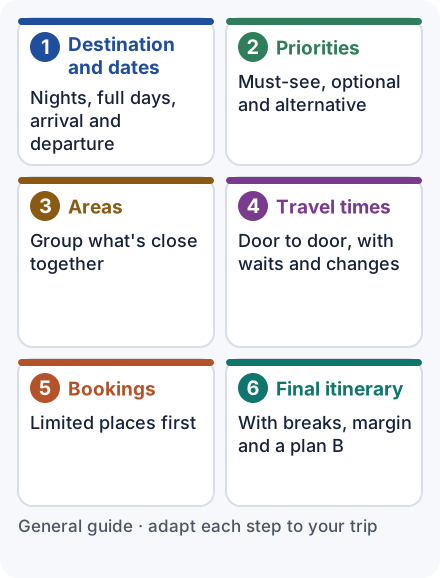
First set the frame: destination, approximate dates and type of trip (culture, nature, food, relaxation or a mix). Then count your time honestly: the number of nights tells you how much accommodation you need, not how many days you'll have for sightseeing.
- Nights don't equal sightseeing days. If you arrive on Monday afternoon and leave on Saturday at midday, that's five nights, but four full days (Tuesday to Friday) and two half days.
- Arrival and departure depend on your transport times: an overnight or very early flight can turn half a day of sightseeing into half a day of rest, and departure day also depends on where you can leave your luggage.
- Travel days between cities usually leave only a few useful hours; count them separately.
Step 2. Decide your priorities
Start with an unfiltered list: monuments, neighbourhoods, museums, landscapes, markets, restaurants, experiences. Then put each item into one of these three groups:
- Must-sees: things you'd be sorry to miss. They get the best time of day and, if needed, a booking.
- Optional: things you'd do if there's time and energy. They fill gaps and are the first to go.
- Alternatives: plans for rain, tiredness or an unexpected closure, ideally close to your must-sees.
A wish list isn't an itinerary yet: it doesn't say when, in what order or how much time is needed. Nor is there a correct number of visits per day: a large museum can take up a morning; three churches in the same neighbourhood might fit into an hour.
Step 3. Research locations and opening hours
For each must-see and each optional item, check its official website or the destination's tourist office and note down:
- Exact address and entrance, which aren't always where the name suggests.
- Opening hours and last entry, which can be well before closing and change with the season.
- Closing days: some places close on a fixed day each week or on certain public holidays.
- Booking: whether there's timed entry or limited capacity, and when sales open.
- Visit length: the one given on the official website, or your own estimate, marked as such.
- Restrictions: minimum age, dress code, accessibility or what luggage is allowed.
Step 4. Group places by area
This is the step that saves the most time: visiting nearby places one after another instead of crossing the city several times. To get from a jumbled list to sensible groups:
- Mark your must-sees, your optional items and your accommodation on a map.
- Circle the places that are a short walk from each other: each group is an area.
- Add up the visit times in each area to see whether it fills a day, half a day or less.
- Share the areas out across the days, starting with whatever has a fixed time or closing day, and avoid going from one end of the city to the other and back on the same day.
- If something is left isolated, give it its own half day or move it to the optional list.
Step 5. Work out real travel times
The advertised time is how long the ride on the train, bus or plane lasts. Door-to-door time runs from when you leave one place until you can start doing something at the next, and it also adds:
- Access: walking to the stop or station, and from your arrival point to where you're going.
- Waits and changes: how often transport runs, changes of line or station and the margin you leave so as not to miss a connection.
- Airports: getting there, check-in or bag drop, security and boarding; on arrival, baggage reclaim and getting into town.
- Accommodation: check-in, check-out and where to leave your bags in between.
Route planners help, but they give estimates; for journeys between cities, check the operator's timetables. If you link up transport from different companies, leave a margin: a delay on the first doesn't oblige the second to wait for you. We explain this for flights in our guide on what to do if you miss a connecting flight.
Step 6. Spread activities across the day
Once the areas and timings are clear, you can build each day. A pattern that works for many travellers is this:
- Morning: the main visit, when you have the most energy and often fewer crowds.
- Midday: lunch and a rest, without rushing.
- Afternoon: a second activity in the same area or a nearby one.
- Evening: something optional, such as a stroll, a special dinner or a show, or simply resting.
It isn't a rule: there are day-trip days, travel days and days with no plan. What matters is not stringing two demanding activities together without a margin, and ending each day near where you're sleeping or with an easy way back.
How to adapt the pace
- With children or reduced mobility: fewer long visits, more breaks and more time between visits, parks between museums and accessibility checked on official websites.
- Museums or food: one big museum a day is usually enough; on a food trip, plan the day around markets and meals, and book the restaurants that require it.
- Nature: start early, check the forecast and daylight hours, and leave enough margin to get back before dark.
- Short breaks or long trips: on a short break, one area or city and no long transfers; on a long trip, rest or laundry days between busy ones.
Step 7. Fit the itinerary to your budget
Every decision in the itinerary has a cost: accommodation (and whether moving halfway through costs more), transport between destinations and locally, admission tickets, meals, guided activities, any booking fees and a margin for the unexpected.
It's enough to note the estimated cost next to each activity and add it up at the end; if you go over, cut optional items before must-sees. To work out the total and a reserve for the unexpected, follow our guide to making a travel budget; if your main transport is a flight, see how to find cheap flights.
Step 8. Work out what to book in advance
Not everything needs booking and not everything can wait; it depends on the destination, the season and the activity. Things that tend to be sensitive to availability include:
- Long-distance transport, especially on busy dates.
- Accommodation, if you want a specific area or are travelling in high season.
- Attractions with limited capacity or timed entry.
- Guided activities in small groups.
- Very popular restaurants, if eating at a particular one is a priority.
Other things can be decided during the trip: places without capacity limits, neighbourhood walks, markets, many restaurants, or the choice between two optional items depending on the weather. There's no universal booking window: check each official website to see whether booking is needed and when sales open, and read the change and cancellation terms before paying. If you're worried about losing what you've paid, check what travel insurance covers.
Step 9. Prepare alternatives
A plan B only works if it's ready before you need it. Next to each day, note three things: an indoor alternative in the same area, the optional item you'd drop if you're short of time or energy, and the bookings that depend on arriving on time. With that, you can react like this:
- Bad weather: switch to the area's alternative, or swap two days if the forecast allows.
- Delays or cancellations: protect timed bookings first and sacrifice optional items.
- Tiredness: drop the optional item you'd already marked.
- Closures or sold-out tickets: check the official website a day or two before; if there's no availability, look for another day or use the alternative.
Step 10. Save and share the itinerary
The best format is the one you'll actually check during the trip:
- Document or spreadsheet: easy to print, sort by day and add up costs.
- Calendar: useful for timed bookings and reminders.
- Map with saved places: to see what's nearby.
- Notes or trip-planning apps: quick to check; make sure they work offline and check which features are free before relying on them.
The details worth saving for each day are in the template below. Add each place's official link and the date you checked its opening hours, and keep booking confirmations where you can open them offline.
Worked example: three days in a fictional city
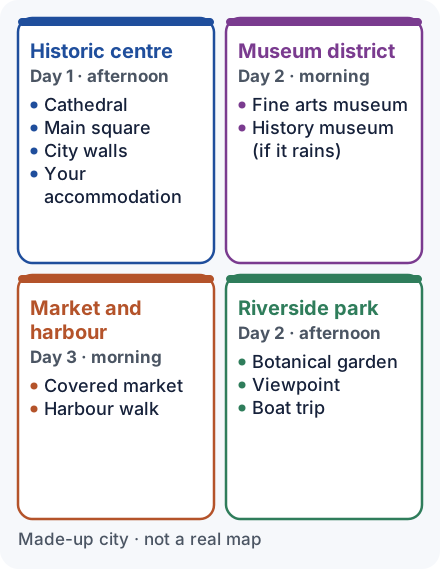
To see the method applied from start to finish, we use a made-up city, the one in the step 4 diagram. All places, opening hours, durations and bookings in the example are fictional: they show how to reason, not details to copy. To see the method applied to real cities, read our itineraries for Rome in 3 days, London in 3 days and Paris in 4 days.
Starting point
- Days: arrival by train on Friday at 11:00 and return on Sunday at 17:00. Two nights: one full day and two half days.
- Must-sees: the cathedral and historic centre, the fine arts museum and the covered market.
- Optional: the botanical garden, the river viewpoint and a boat trip.
- Rainy-day alternative: the history museum, in the same district as the fine arts museum.
- Checked beforehand: the fine arts museum closes on Mondays, the cathedral and the museum use timed entry, and the market opens only on Sunday morning. The accommodation is in the historic centre, a 15-minute walk from the station.
Day 1 (Friday): arrival and historic centre
- 11:00–12:15: arrival, walk to the accommodation and leave the bags. It's a half day: nothing else planned.
- 12:30: lunch near the accommodation.
- 14:30–17:00: historic centre on foot: cathedral at 15:00 (timed entry), main square and city walls.
- 17:00–18:30: check-in and rest.
- Evening: dinner in the old town; optionally, back to the walls at sunset.
Day 2 (Saturday): museums and riverside park
- 10:00–12:30: fine arts museum with first-slot entry: the longest must-see gets the best part of the day.
- 12:30–15:00: lunch and a break in the museum district.
- 15:00–15:30: tram to the riverside park, including the wait and the walk to the entrance.
- 15:30–18:30: botanical garden and the viewpoint late in the afternoon.
- Evening: boat trip if there's energy left; if not, a quiet dinner.
Day 3 (Sunday): market, harbour and departure
- 9:30: check out and leave the bags at the accommodation's luggage room.
- 10:00–13:00: covered market (open only in the morning on Sundays) and a walk around the harbour.
- 13:00–14:30: lunch at the harbour.
- 14:30–16:15: walk back, collect the bags and walk to the station.
- 16:15–17:00: margin before the train.
If it rains on Saturday
In the afternoon, the history museum replaces the park: same district, no travel. The botanical garden and the viewpoint were optional and are dropped. Sunday doesn't change, because the market is a must-see and only opens in the morning.
Why it works better than a list of attractions
A jumbled list might have put the museum on Friday, straight off the train with your bags, or the market on Sunday afternoon, when it's already closed. This plan gives each half day to one area, books only what has a time slot, keeps arrival and departure days light and ends at the station with a margin. If something goes wrong, you only lose an optional item.
How planning changes with the length of the trip
The method is the same; the weight of each step changes. These are only guidelines: ten days in a single city is as valid a trip as ten days across five.
Two or three days
Focus on one city or area and avoid long journeys: a full-day excursion already takes up a third of the trip. Your must-sees should be close to where you're staying.
Five to seven days
You can combine several areas of one city with one or two day trips, or two well-connected destinations. If you change accommodation, count that day as a travel day with light sightseeing.
Ten to fourteen days
Changes of accommodation, long journeys and rest come into play. Build in a quiet day every few days, and prefer several nights at each base to constantly moving on.
Signs that a route is too ambitious
- There are more days with transfers than days without.
- You sleep just one night in several places in a row.
- A day depends on every connection running on time.
- There's no free time anywhere in the trip.
- When you add up door-to-door times, a day has more hours of transport than of sightseeing.
Itinerary template to copy
Copy these fields into a document, a note or a spreadsheet (one column per field) and fill in one entry for each day or half day:
- Day and date:
- City or area:
- Main activity:
- Secondary activity:
- Planned transport:
- Estimated time (visit + travel):
- Booking needed (yes/no, time, where the confirmation is):
- Approximate budget:
- Alternative:
- Notes (verified hours, official link, date checked):
Filled-in example (Saturday from the example): day 2, Saturday · museum district and riverside park · fine arts museum, 10:00–12:30 · botanical garden and viewpoint · on foot and by tram (about 30 min) · about 7 h with lunch and breaks · yes: museum at 10:00, confirmation in email · tickets, lunch and tram · history museum if it rains · closes on Mondays; hours checked the week before.
Digital tools that can help
You don't need any particular app. We checked these features in Google's official help; they can vary by device, country or mode of transport, and other tools offer similar features:
- Lists in Google Maps: save places to private or shared lists and let other people view or edit a list (help). One list per area makes step 4 visible.
- Offline maps: you can download areas, but offline there are only driving directions, not transit, cycling or walking; downloads aren't available in some countries and maps expire if they aren't updated (help).
- Departure or arrival time: on a computer you can plan a route for a specific time and get an estimated travel time, only for routes with a single destination (help).
- Google My Maps: imports places from CSV or XLSX files or from Google Sheets into layers, so you can turn the template into a map (help).
- Google Calendar: lets you set different time zones for the start and end of an event, useful for a flight across time zones (help).
Mentioning them isn't a recommendation: we haven't compared apps and receive nothing for naming them. With paper, a map and a spreadsheet you can apply the whole method.
Common itinerary mistakes
- Filling every hour: without gaps, any delay throws the day off.
- Counting arrival day as a full day.
- Checking opening hours but not last entry, closing days or local holidays.
- Counting only the ride instead of door-to-door time.
- Changing accommodation too often: every move uses up hours.
- Chaining timed entries separated by a tight journey.
- Adding activities without reviewing the budget.
- Keeping bookings only in your email, with no copy you can open offline.
Frequently asked questions
How many activities should I plan per day?
There's no universal figure. A practical reference is one main activity per morning or afternoon, with an optional item nearby in case there's time left. With children, in hot weather or on long trips, plan fewer.
How do I plan an itinerary without knowing the destination?
Start with the official tourism website, which often groups places by neighbourhood, and mark them on a map. Guidebooks and other travellers' accounts are good for ideas; opening hours and requirements should be confirmed with official sources.
Is it better to book everything?
No. Book what has limited places or shapes the rest of the day. The more bookings you have without free changes, the less room you have to adapt.
How do I organise several destinations in one trip?
First decide how many nights you'll spend at each base and count every move as a travel day. Order the destinations so you move forward without backtracking, and check that transport between them runs on the dates and at the times you need. If you end up with more transfers than quiet days, drop a destination.
How do I plan an itinerary with children?
As well as slowing the pace, check official websites for child prices and rules and whether pushchairs are allowed, and choose accommodation close to the main areas so you can go back for a midday rest.
What if I don't manage to see everything I planned?
It's normal: that's what optional items are for, and they go first. If a must-see is left, look for a gap on another day in the same area or swap an optional visit for it.
Sources consulted
Consulted on 18 October 2026.
- Google Maps: create a list of places
- Google Maps: download areas and navigate offline
- Google Maps: get directions and show routes
- Google My Maps: import map features from a file
- Google Calendar: use Google Calendar in different time zones
- Your Europe: documents you need to travel in Europe
- Spanish Ministry of Foreign Affairs: travel recommendations (in Spanish)
An itinerary doesn't have to be perfect, just realistic: organised enough not to waste time and flexible enough to enjoy the unexpected. Start by counting your real days.
Related guides

Travel
How to make a travel budget step by step (with examples)
A practical travel budget method: estimate transport, accommodation, meals and activities, separate paid from outstanding costs, and track spending.
13 min read

Travel
Rome in 3 days: a complete itinerary for a first visit
Plan three full days in Rome with a practical route through ancient Rome, the historic centre and the Vatican, plus booking, transport and timing advice.
12 min read

Travel
Paris in 4 days: a complete itinerary for a first visit
Four days in Paris organised by area: Notre-Dame and the Latin Quarter, the Louvre, the Eiffel Tower, Montmartre and Le Marais, with bookings, closures, transport and budget.
24 min read