
Missed a connecting flight? What to do, your rights and how to claim
What to do at the airport, the difference between one booking and separate tickets, care and compensation under EU rules, and how to claim if the airline doesn't respond.
By TopicWeekPublished 15 min read
In this article
You land late at your connecting airport, rush through the terminal and the screen already shows your next flight as closed. What you can ask for depends mainly on three things: why you missed the connection, how you bought the flights (one booking or separate tickets) and which rules apply to your itinerary.
This guide explains what to do at the airport and when you may be entitled to care, another flight, a refund or compensation, focusing on EU rules and the key differences in the UK, the US and elsewhere. It is general guidance: your actual rights depend on your itinerary, your ticket and the rules that apply. If your flight is cancelled or delayed without a missed connection, see our guide to delays and cancellations.
What to do at the airport if you miss your connection
Seats on the next flights go quickly, so act straight away. Some of these steps are rights; others are practical tips.
- Check the real status of the next flight: it may be delayed too, and you might still board.
- Go to the transfer or airline desk, or use the app or phone line if the queue is long.
- Ask about alternatives: the airline's next flight, a partner airline's flight or another route.
- Get the new booking in writing and, if possible, the reason for the delay.
- Ask what happens to your checked bags: whether they'll follow you or you need to collect them.
- Ask about meals, a hotel and transfers if the wait is long or the flight leaves the next day.
- Keep tickets, boarding passes, bag tags and messages, and take screenshots of the flight screens.
- Record any reasonable expenses you pay yourself, with receipts and invoices.
One booking or separate tickets: the key difference
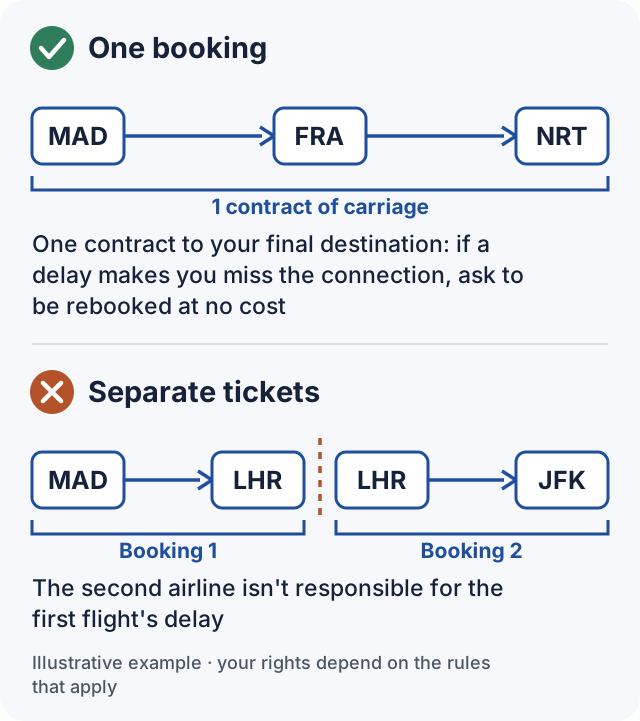
Before claiming anything, find out whether your flights form a single contract of carriage or separate purchases. The European Commission's guidelines treat connecting flights booked as a single unit as one whole.
Case A: a connection on one booking
Hypothetical example: you book Madrid–Frankfurt–Tokyo as one booking. The first flight arrives late and you miss the Tokyo flight. Because the contract of carriage runs to Tokyo, ask the airline to rebook you on the next available flight at no extra cost; current EU rules don't expressly regulate rebooking after a missed connection (the reform will), so keep a record of the answer. What is recognised today is compensation: if you reach Tokyo three hours or more late and there were no extraordinary circumstances, you may be entitled to it, because the journey starts in the EU (Folkerts, C‑11/11). And if, on a single booking with a single check-in, the airline refuses you boarding on the second flight because it thinks you won't make it in time, that's denied boarding, with compensation and a choice between a refund and another flight.
None of this covers a connection missed through your own fault, such as reaching the gate late. The EU Court of Justice has allowed passengers to claim from the EU airline that operated the first flight even when the delay happened on the second flight, operated under a codeshare by a non-EU airline (case C‑502/18).
Case B: tickets bought separately
Hypothetical example: you book Madrid–London on one booking and London–New York on another. If the first flight is delayed and you miss the second, under the Commission's guidelines the first airline doesn't have to compensate you for the missed connection, and no rule obliges the second to wait for you or rebook you for free. Each flight does keep its own rights: if the first arrives in London three hours or more late, or is cancelled, you can claim for that flight. Paying for the lost second ticket isn't part of those rights; any claim for further damages would depend on the Montreal Convention or the applicable law and the specific case. This is the self-transfer risk we also cover in how to find cheap flights.
- Contact the second airline as soon as possible and ask whether it can change your flight and at what cost; if it does, that's its own policy.
- Check your fare rules: changes, fees and what happens to later legs, such as the return, if you don't show up.
- Check your travel insurance or card cover: some policies cover missed connections, depending on their terms.
- If the agency offered a connection guarantee, check how it works: it's a commercial promise, not a legal right.
Ticket, booking and booking reference: details worth knowing
- One booking: the flights are sold together under a single contract to your final destination. This is the most protected option.
- Booking reference: the code that identifies the booking. Sharing one usually indicates a single booking, but doesn't prove it on its own: what matters is how the tickets were issued.
- Separate tickets: independent contracts, even if you paid in one transaction or on one website.
- Codeshares and partner airlines: a flight may be sold by one airline and operated by another. EU obligations fall on the airline that operates it.
- Flights combined by an agency: if the agency charges an overall price and issues a single ticket, the EU Court of Justice treats them as a connecting flight even if the airlines have no agreement with each other (case C‑436/21). By contrast, a self-transfer sells separate tickets as one trip, and you usually collect and re-check your bags (Google Travel explains it); any guarantee depends on the seller.
Which rules apply: EU, UK, US and the rest of the world
There's no worldwide rule: it depends on where the flight departs, where it's going and sometimes the airline's nationality. The language of this guide doesn't change the applicable law; your itinerary does.
European Union
- Regulation (EC) 261/2004 applies to flights departing from the EU, with any airline.
- It also applies to flights arriving in the EU from outside, if operated by an EU airline; on a journey with stops from outside the EU, only flights operated by EU airlines count.
- It doesn't cover a journey that starts and ends outside the EU even if it stops in the EU (case C‑451/20), nor does it apply if you already received benefits for the same journey under a non-EU country's law.
- According to Your Europe, it also covers flights to and from Iceland, Norway and Switzerland, and territories such as the Canary Islands, the Azores and Madeira.
United Kingdom
The UK applies its own version (UK261), very similar but with amounts in pounds. According to the Civil Aviation Authority (CAA), on a single booking the airline must provide care if you miss the connection because of a delay on the first flight and the new flight goes beyond the waiting-time thresholds, including a hotel if you have to stay overnight; compensation depends on your arrival at the final destination. With separate tickets you have no legal right to care, compensation or onward transport for the missed connection, although each flight keeps its own entitlements. The CAA publishes a table of covered flights.
United States
In the US there's no general federal requirement to pay cash compensation for delays or missed connections. The Department of Transportation (DOT) does require a refund if the airline cancels or significantly changes your flight and you choose not to travel; for arrivals, that includes delays of three hours or more on domestic flights and six or more on international ones. If you accept the alternative flight or travel, there's no refund (DOT: refunds). Rebooking, meals and hotels depend on each airline's voluntary commitments when the cause is within its control, listed on the DOT dashboard. A flight departing the EU for the US, or arriving in the EU with a European airline, may also be covered by EU rules.
Rest of the world
Local laws, the airline's conditions of carriage and, on international flights, the Montreal Convention, which governs liability for damage caused by delays and for baggage, may apply. Check your ticket and contact the aviation or consumer authority of the relevant country.
Care, an alternative flight, a refund and compensation are not the same
- Care: food, drink, communication, a hotel and transfers while you wait.
- Alternative transport: another flight to your final destination at no extra cost, when the contract or the rules require it.
- Refund: your ticket money back, for example if the delay is very long and you give up the trip.
- Compensation: a fixed amount for the inconvenience, only when specific conditions are met, unrelated to what you spent.
Meals, a hotel and transport while you wait
According to Your Europe, if a flight covered by EU rules departs late, the airline must offer food, drink and two calls or emails from these thresholds:
- 2 hours or more: flights of up to 1,500 km.
- 3 hours or more: intra-EU flights over 1,500 km and other flights between 1,500 and 3,500 km.
- 4 hours or more: all other flights.
If the departure is put back to the next day, you're entitled to a hotel and transfers. The current rules have no separate section for missed connections, but the Commission's guidelines say care should also be provided at the connecting airport, in proportion to the wait (the 2027 reform will say so expressly). If it isn't offered and you pay yourself, you can claim back necessary and reasonable expenses. And if your flight departs five hours or more late, you can give up the trip, ask for a refund and, on a connection, a flight back to your starting point.
When compensation may be due (EU rules)
It isn't automatic. According to Your Europe and the EU Court of Justice (Folkerts, C‑11/11), these conditions must be met:
- The journey falls under Regulation 261/2004 (for example, it departs from the EU).
- The flights were on one booking.
- You reach your final destination three hours or more late; arrival at the connecting airport doesn't count.
- The cause is not an extraordinary circumstance the airline can prove.
- You didn't miss the connection through your own fault, such as reaching the gate late or being held up at security.
The amount depends on the distance between the departure airport and your final destination, measured in a straight line rather than by adding up the legs:
- €250: up to 1,500 km.
- €400: intra-EU flights over 1,500 km and other flights between 1,500 and 3,500 km.
- €600: over 3,500 km.
On journeys of more than 3,500 km between the EU and a non-EU country, a delay of between three and four hours can halve the compensation (€300). In the UK, the CAA gives £220, £350 and £520, and £260 for flights over 3,500 km arriving between three and four hours late. You claim from the airline that operates the flights, not from the agency.
If the delay is caused by bad weather or another extraordinary circumstance
This is an event the airline couldn't have avoided even by taking all reasonable measures. In that case it doesn't pay compensation, but it isn't released from providing care: the Regulation makes no such exception for care during delays, and the Court of Justice confirmed that care is due even in extraordinary circumstances, in a case about cancellations caused by the 2010 volcanic ash (McDonagh, C‑12/11).

- Usually extraordinary: weather incompatible with safe flying, air traffic control decisions, security risks, political instability and strikes outside the airline, such as by air traffic controllers.
- Usually not: most technical faults and strikes by the airline's own staff.
- Each case is assessed separately: bad weather isn't an automatic exemption; the airline must prove the cause and that it couldn't avoid the delay.
Ask for the explanation in writing. The airline may also rely on a problem that affected an earlier flight by the same aircraft, but it must show a direct link to your delay, according to the Commission's guidelines.
If the connection is missed for reasons on the passenger's side
According to the Commission and Your Europe, missing a connection because of delays at security checks or not respecting the boarding time gives no right to compensation. Situations like these are not usually the airline's responsibility either:
- Reaching the gate after boarding has closed, even though the previous flight arrived on time.
- Personal delays at security, passport control or when changing terminals.
- Not having the required passport, visa, travel authorisation or other transit requirements.
- Very tight connections you booked yourself on separate tickets.
What to do about checked baggage
On a single booking, bags are usually checked through to your final destination, but it depends on the airlines and on controls in some countries; with separate tickets you normally collect and re-check them. There's no universal rule: always ask.

- Ask at the transfer desk whether your bag will follow you to the new flight, and keep your bag tag.
- If it doesn't arrive, report it at the baggage desk before leaving the airport and keep the report.
- Claim in writing from the airline: according to Your Europe, within 7 days if it's damaged or lost and within 21 days of receiving it if it was delayed.
- Keep receipts for essential purchases: baggage liability has limits set by the Montreal Convention.
How to claim, step by step
- Gather your documents: booking, boarding passes, bag tags, messages, screenshots and receipts.
- Identify the responsible airline: the one that operated the delayed flight or, on a single booking, one of the airlines that operated your journey. Watch out for codeshares.
- Use the airline's official claim form.
- Explain the facts and what you're asking for: flights, scheduled and actual times, arrival at the final destination, expenses and, if applicable, compensation.
- Keep proof of sending and any replies.
- If there's no reply or you disagree, go to the competent body for the country concerned.
If the flight departed from or arrived in Spain
Spain's aviation safety agency (AESA) decides claims about rights under Regulation 261/2004, such as delays, cancellations or denied boarding. Under Order TMA/201/2022, it covers flights departing from Spain and flights from outside the EU to Spain operated by EU airlines. You first claim from the airline, which has one month to reply; if it doesn't reply or you disagree, you have one year from that claim to go to AESA. For incidents since 2 June 2023, AESA's decision binds the airline, but not you: you can still go to court. It's free; the legal time limit is 90 days, extendable in complex cases, and if no decision is issued in time the claim is deemed rejected.
If the problem happened in another country
Elsewhere in the EU, Your Europe advises claiming from the airline first and, if there's no reply within two months or you disagree, contacting the national body in the country where the incident happened (Commission list), whose decisions aren't always binding. If you live in the EU, you can also use an alternative dispute resolution body, contact the European Consumer Centres Network or use the European Small Claims Procedure. There's no single EU deadline: it depends on each country's law.
In the UK, if the airline doesn't reply within eight weeks or you're unhappy with its answer, the CAA points you to the airline's alternative dispute resolution body or to its own complaints service. In the US, the DOT accepts online complaints and forwards them to the airline.
Examples of common situations
Hypothetical cases under EU rules, for guidance only; they don't predict the outcome of a claim.
- One booking, first flight delayed: ask for rebooking under your contract and care while you wait; compensation possible if you arrive three hours or more late and there were no extraordinary circumstances.
- Two separate tickets: nobody is obliged to rebook you for free; you could only claim for the first flight if its own delay or cancellation gives you rights.
- Extraordinary circumstances, such as a storm: usually no compensation, but you're still entitled to care.
- Alternative flight the next day: a hotel and transfers if the delay entitles you to care; compensation depends on your arrival at the final destination and the cause.
- Reaching the gate late: if the first flight arrived on time, there's no compensation and any change depends on your fare.
How to reduce the risk of missing a connection
- Respect the minimum connection time and add extra margin in peak season, in winter or at large airports. There's no universal “safe” time.
- Choose a single booking for important connections.
- Check whether you'll need to change terminals, go through passport control or collect your bags.
- Check the transit or visa requirements of the connecting country.
- With separate tickets, leave a wide margin or stay overnight at the stopover, and consider insurance that covers missed connections.
- Pack your hand luggage for another security check: duty-free liquids may have special rules (carry-on luggage guide).
Frequently asked questions
Do I have to pay for a new flight if I miss my connection because of a delay?
On a single booking, usually not: your contract covers the trip to your final destination, so ask to be rebooked at no extra cost and get it confirmed in writing. With separate tickets it depends on the second airline, and you may have to pay.
How long do I have to claim?
The current EU rules don't set a single deadline. In Spain, the AESA order allows five years to claim from the airline and one year from that claim to go to AESA. For baggage, the deadlines are 7 and 21 days.
Can I be given a voucher instead of money?
Under Regulation 261/2004, compensation is paid in money; a voucher is only possible if you agree to it in writing.
Can I claim expenses and compensation?
Yes, if the conditions for each are met: they're different things. Some airlines ask you to submit them separately.
Do I need a claims company?
It's not required: you can claim from the airline and then from the competent body; in Spain, AESA is free. If you hire a company, check its fee first.
In short: act fast, check whether your connection was on one booking, tell care, refunds and compensation apart, and keep the evidence. This guide reflects the rules in force in October 2026; the EU reform will change some rules from 23 October 2027.
Related guides

Travel
How to find cheap flights: tips, search tools and mistakes to avoid
Compare dates, airports and total costs, use search tools and price alerts carefully, and check baggage, connections and booking terms before paying. No trick guarantees the lowest fare.
14 min read

Travel
Carry-on luggage on a plane: what you can bring and what is restricted
Prepare cabin baggage with practical guidance on airline allowances, liquids, medicines, food, electronics, batteries and restricted items. Rules differ by airport, airline and destination.
9 min read

Travel
Japan in 10 days: a first-trip itinerary
A realistic 10-day Japan itinerary for a first visit, linking Tokyo, Kyoto and Osaka with transport, budget, entry and booking advice.
22 min read