
How much does it cost to buy a home in Spain? Deposit, taxes and fees
Estimate the cash needed to buy a home in Spain: down payment, taxes, transaction costs and practical examples.
By TopicWeekPublished 8 min read

In this article
The asking price is not all the money you need to buy a home. If you take out a mortgage, you must contribute the part the lender does not finance and pay purchase taxes and other transaction costs. The total changes with the property type, location and financing you obtain.
How much cash do you need before buying?
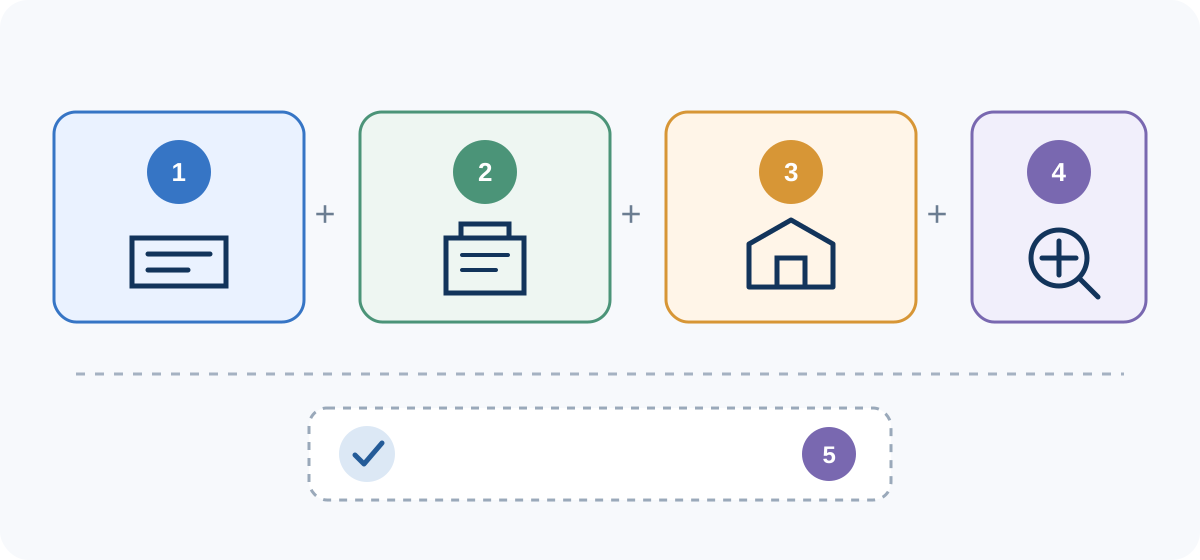
A useful way to organise the budget is: cash to complete = own contribution to the price + acquisition taxes + purchase and financing costs payable by the buyer + other expected outlays. Keep an emergency reserve separate: it is neither a tax nor a legal requirement, but using all your savings at completion can leave no room for moving, repairs or an income gap.
The down payment depends on financing, not a universal rule
The down payment is the part of the price not covered by the loan. If a lender financed 80% of a €250,000 home, the loan would be €200,000 and the contribution to the price €50,000. That 80% is only a calculation assumption: the lender assesses income, debts, stability, security and valuation; there is no entitlement to that amount. Some lenders calculate the limit against the lower of price and valuation, so a lower valuation can increase the cash required. A valuation does not guarantee approval. The Bank of Spain explains how a home is valued and a mortgage assessed.
Resale homes: regional transfer tax
A resale home usually incurs Property Transfer Tax (ITP), paid to the autonomous community where the property is located. Standard rates and reliefs vary by territory and buyer circumstances. Madrid publishes a 6% general rate for property; Catalonia publishes a 10% general rate up to €600,000 for transfers covered by that tariff. Reduced rates and special regimes exist: check the regional tax authority for current conditions. Spain’s Tax Agency distinguishes VAT from ITP transactions. In Madrid, an individual buying a habitual residence whose total qualifying value (including relevant annexes such as up to two parking spaces and a storage room) does not exceed €250,000 may, if eligible, claim a 10% rebate on the ITP tax liability; this does not lower the general rate. The main examples use the general rate and exclude this rebate.
New homes: VAT and stamp duty (AJD)
The first supply of a completed home by its developer is generally subject to 10% VAT; a 4% rate applies to certain protected homes. A later transfer is usually subject to ITP. The law defines a first supply and provides exceptions, including based on prior continuous use: a building’s age alone does not determine its tax status. A VAT-taxed transaction may also incur AJD stamp duty on the acquisition deed, at a regional rate. In Madrid, the general AJD rate for a free-market home valued above €180,000 is 0.75% as of the cut-off date; check for exemptions or reliefs. See the Tax Agency, the VAT Act and Madrid’s official rates. In Madrid, an individual acquiring a habitual residence with a qualifying total value no higher than €250,000 may also be eligible for a 10% rebate on the AJD liability for the acquisition deed. This is separate from AJD on the mortgage deed, for which the lender is the taxpayer. On 5 October 2026 the region announced possible 2027 reductions, but as of 15 October no published, effective rule applying them was identified; they are not used here. The official announcement describes those proposed measures.
Check the cadastral reference value, not only the price
For some transfers subject to ITP, the Cadastre’s reference value can be the minimum taxable base. If the declared value, price or consideration is higher, the higher amount is used under the applicable rule. It is not the cadastral value—which, among other purposes, is used for local property tax—and does not necessarily equal the price or mortgage valuation. Check the reference value before budgeting and review the available procedure if you dispute it. The Cadastre explains the distinction and tax use.

Notary, Land Registry and conveyancing costs
The purchase deed and its registration generate costs governed by tariffs and document details; there is no single amount for every transaction. As a default rule in the Civil Code, the seller pays for executing the deed and the buyer for copies, unless agreed otherwise; the Notarial Council notes regional variation and contractual allocation. Registration of the acquisition is generally for the buyer. A developer cannot pass on costs legally assigned to the seller, such as cancelling its mortgage or registering the new build and subdivision. See the General Council of Notaries guide and article 1455 of the Civil Code.
Which mortgage costs does each side pay?
For loans covered by Law 5/2019, the borrower pays the valuation. The lender pays the agency, notarial fees for the loan deed, registration of the security and taxes under tax law. The customer may pay for a copy they request and an opening fee only if agreed and valid. These costs are separate from the purchase deed. The Bank of Spain summarises the allocation; Law 5/2019, article 14 sets out the rule.
A deposit is usually credited to the price, not added to it
Arras are an amount agreed in a private contract. If credited against the price at completion, they are an advance: do not count them again as an extra cost. Their effect depends on the type and wording of the agreement; article 1454 of the Civil Code governs penitential arras, but not every contract labelled “arras” automatically creates the same right to withdraw. If you need the purchase to depend on mortgage approval, agree in writing what happens if the loan is refused. Read the contract before transferring money and seek professional review if in doubt.
Reproducible example: a €250,000 resale home in Madrid
Assume an unrestricted resale home, no personal tax relief; a €250,000 price and ITP base; no reference value above that amount; an 80% mortgage; and an illustrative €1,500 allowance for valuation and buyer-paid transaction costs. That allowance is not a tariff or quote: notary, copies, Land Registry, optional administration and valuation costs vary and should be quoted. It excludes renovation, an agency fee if agreed as buyer-paid, moving and an emergency reserve.
- Contribution to price: €250,000 × 20% = €50,000. Assumed loan: €200,000.
- ITP: €250,000 × 6% = €15,000, assuming a €250,000 tax base and no reduced rate.
- Other budgeted costs: €1,500 as a round assumption, not a statutory percentage or official tariff.
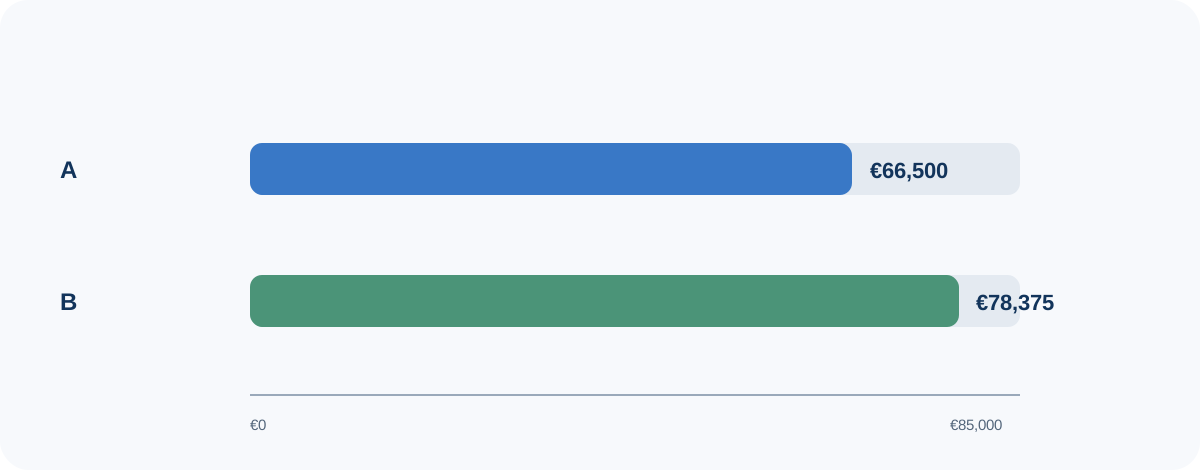
- Estimated cash to complete: €50,000 + €15,000 + €1,500 = €66,500. Keep your household’s liquidity buffer separate.
- If the purchase is for a habitual residence and you qualify for Madrid’s 10% rebate on the tax liability (with a qualifying total value up to €250,000), ITP in this example would fall to €13,500 and estimated cash to €65,000. The main scenario excludes the rebate and assumes no annexes that take the qualifying value above the limit.
Same price, new home in Madrid
At the same price, financing and cost allowance, a first supply of a €250,000 free-market home would incur €25,000 VAT (10%) and €1,875 AJD (0.75% on an assumed €250,000 base) in this example. Adding a €50,000 contribution and €1,500 other costs gives €78,375. This is an illustration, not an assumption that new and resale homes always cost the same or a confirmation of every transaction’s tax base. Protected housing or a different tax base can change the result. If the buyer qualifies for Madrid’s 10% AJD liability rebate for a habitual residence with a qualifying value up to €250,000, AJD would be €1,687.50 and the estimated total €78,187.50. The main example excludes this rebate. It concerns only the acquisition deed, not the mortgage deed.
How the cash requirement changes with price
Under the same Madrid resale assumptions—tax base equal to price, 6% general ITP, 80% financing and the same illustrative fixed €1,500 allowance—the cash to complete is: €200,000 home: €53,500 (€40,000 + €12,000 + €1,500); €250,000: €66,500; €300,000: €79,500 (€60,000 + €18,000 + €1,500). The fixed allowance only makes the effect of price visible; it does not assume professional costs are always identical. Recalculate if the tax base, loan share or actual costs differ. For a buyer eligible for Madrid’s 10% liability rebate on a habitual residence with a qualifying value no higher than €250,000, the €200,000 example would fall by €1,200 (total: €52,300) and the €250,000 example by €1,500 (total: €65,000); eligibility and included annexes matter. The €300,000 example is above that limit.
What to check before paying a deposit
- Request a recent Land Registry extract: ownership, property description and registered charges.
- Check who occupies the home, its condition and any relevant planning or habitability documents.
- Compare the cadastral reference, reference value and floor area; they are not interchangeable figures.
- Ask about community fees, possible arrears and known special assessments; request the relevant information or certificates.
- Ask the bank for a financing assessment before taking on commitments and compare valuation with price.
- Read the deadlines, amounts, financing conditions and consequences of withdrawal in the arras contract.
- Separate closing taxes and costs from renovation, furniture, utilities, moving and post-purchase liquidity.
The budget does not end at completion
Afterwards there may be mortgage payments, local property tax, community charges, insurance, maintenance, repairs and utilities. They do not all work the same way or cost the same. If you are also deciding whether to buy or keep renting, read our guide to comparing the real costs of both options in Spain. If you are choosing where to search, see where purchase prices are lower; a lower price does not remove purchase taxes and fees.
Frequently asked questions
Do I need exactly 30% of the price in savings? No. An 80% mortgage plus taxes is a reference used in some budgets, but the loan share, taxes, taxable base and costs vary. Calculate the specific transaction.
Does the bank pay every home-buying cost? No. Law 5/2019 allocates costs for formalising the mortgage loan; it does not remove purchase taxes and conveyancing costs or require the bank to finance the down payment.
Are arras added to the down payment? They are usually credited against the price if the contract says so: an advance, not another cost. Check the contract wording.
Conclusion: budget for the transaction, not only the deposit
To estimate the cash you need, separate the contribution to the price, taxes, buyer-paid costs and your personal reserve. Check whether the home is new or resale, its region, reference value, financing share and the agreed allocation of costs. The examples make a simple calculation reproducible, but the actual amount requires documents and quotes for the specific purchase.
Related guides

Money
Should you buy or rent a home in Spain? How to compare the real costs
Compare the costs of buying and renting a home in Spain, including a deposit, mortgage, taxes, maintenance and a reproducible example.
11 min read

Money
The cheapest places to buy a home in Spain in 2026
The autonomous communities, provinces and municipalities with the lowest housing prices in Spain in 2026, with official appraisal and sales data, asking prices and how to read each figure.
10 min read

Money
Credit Card vs. Debit Card: Differences and Which to Choose
Understand how credit and debit cards use money, when interest or fees may apply, and what to check before choosing.
11 min read